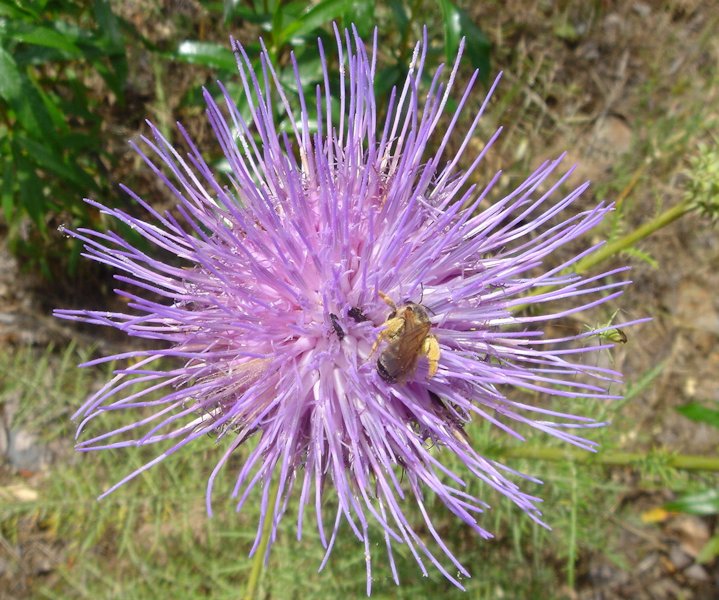
photographed in Spain
photographed in Spain
Perennial of the Asteraceae family, Cynara humilis is native to the Iberian Peninsula and the Maghreb, where it grows in garrigues, dry grasslands, and rocky paths on poor, well-drained soils, under a hot and dry Mediterranean climate, generally below 800 meters in altitude.
It forms a low rosette, with remarkably fine and deeply cut leaves, almost filiform, grayish and slightly tomentose, giving it a feathery and silvery appearance very different from the large cultivated cynaras. The slender flowering stems bear numerous globular capitula surrounded by rigid and spiny bracts, tinged with dark purple at the base, topped with a tuft of bright pinkish-lilac tubular flowers.
In its natural habitat, its flowering extends from June to August.
It is the smallest and most finely cut of the wild cynaras. Its capitula are very visited by bees and various insects, as evidenced by the field photographs.
In cultivation, it requires well-drained soil, dry to moderately dry, in full sun, and withstands summer heat well. It tolerates moderate cold but fears stagnant moisture in winter.