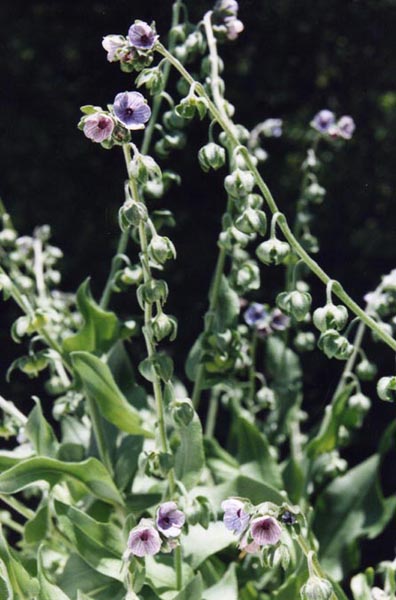
Perennial or biennial of the Boraginaceae family, Cynoglossum creticum is native to the Mediterranean basin, from the Iberian Peninsula to the Near East, including southern France, Italy, Greece, and North Africa. It grows in wastelands, open garrigues, roadsides, rocky slopes, and abandoned fields, on dry, calcareous, or stony soils, in full sun, generally below 1,000 meters in altitude.
It forms an upright, robust plant, reaching 30 to 80 cm in height, entirely covered with a dense grayish tomentum that gives it a characteristic velvety and whitish appearance. The leaves are lanceolate, soft to the touch despite their woolly appearance, the lower ones long-petioled, the upper ones sessile and clasping. The flowers, arranged in scorpioid cymes typical of Boraginaceae, are a delicate blue-violet veined with darker lines, pinkish in bud, reminiscent from afar of some forget-me-nots.
In its natural habitat, its flowering extends from April to July.
An immediately observable distinctive detail: the fruits are covered with small rigid hooks that cling to clothing and animal fur, thus ensuring effective dissemination over long distances.
In cultivation, it is content with ordinary soil, dry to well-drained, in a sunny exposure. It self-seeds spontaneously and can form natural colonies in Mediterranean-style gardens or dry rockeries.