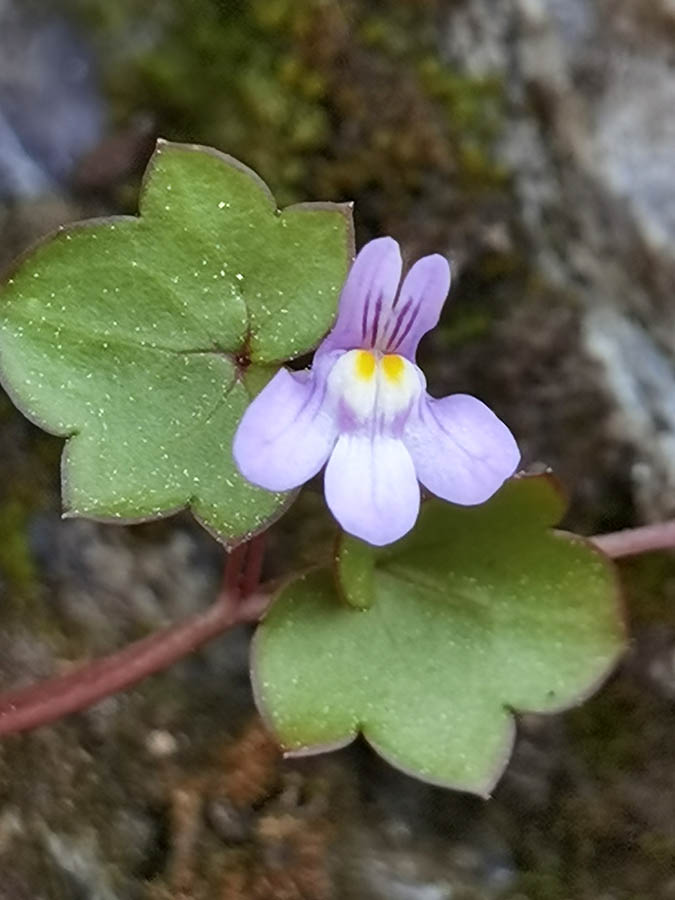
A perennial of the Plantaginaceae family, Cymbalaria muralis is native to Italy and northern Mediterranean regions, but it has naturalized in much of temperate Europe, where it spontaneously colonizes old walls, stone joints, shaded rockeries, and damp paving crevices, from the plains to medium altitudes.
The plant is creeping and trailing, forming fine curtains of thread-like stems that can reach 30 to 60 cm in length. The leaves, small, kidney-shaped to palmately lobed, with a slightly fleshy bright green, are alternately arranged along the stems, giving it a delicate and airy appearance. The flowers, tiny, resemble in miniature those of a snapdragon: they are lilac to pale violet, with a yellow palate and a closed throat, borne individually on slender peduncles.
In its natural habitat, its flowering extends from April to October. In cultivation, it can bloom almost continuously from March to November in sheltered situations.
A singular behavioral detail deserves mention: after fertilization, the floral peduncle bends and actively directs the capsule towards the dark crevices of the wall where the seed can germinate, thus ensuring the colonization of the support.
It thrives in shaded to semi-shaded situations, in poor and well-drained soil, and perfectly tolerates moderate drought once established.