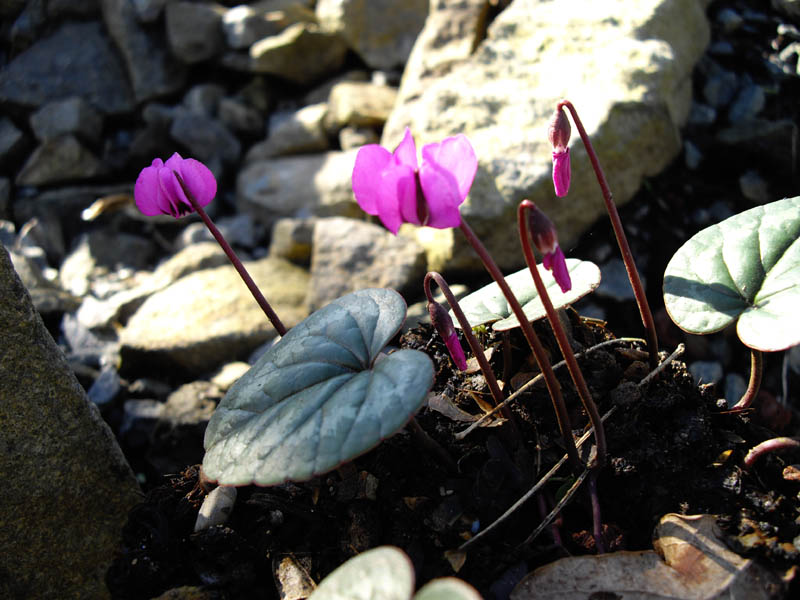
Tuberous perennial of the Primulaceae family, Cyclamen coum is native to the Near East and the Caucasus, with a range extending from Turkey to Iran, through Bulgaria and Greece. It naturally grows in clear undergrowth, oak and conifer forests, shaded edges, and rocky slopes, generally between 0 and 2,000 meters in altitude.
The plant is low, barely exceeding 8 to 10 cm in bloom. The foliage is remarkable: the leaves, kidney-shaped to almost round, dark green often marbled with silver or gray, persist all winter and constitute a lasting ornament on their own. The flowers, borne on slender peduncles, are pink to bright pink, sometimes white, with the reflexed petals characteristic of cyclamens, with a dark purple spot at the base.
In its natural habitat, its flowering extends from January to March. In cultivation, it occurs as early as December depending on the winters, making this species one of the first to bloom in rock gardens.
The tuber, flattened and corky, should never be buried deeply; it is placed almost at ground level, under a light layer of humus. Cultivation requires well-drained soil, in shade or partial shade, at the foot of trees or rocks. Summer drought, a period of vegetative rest, is essential for it.