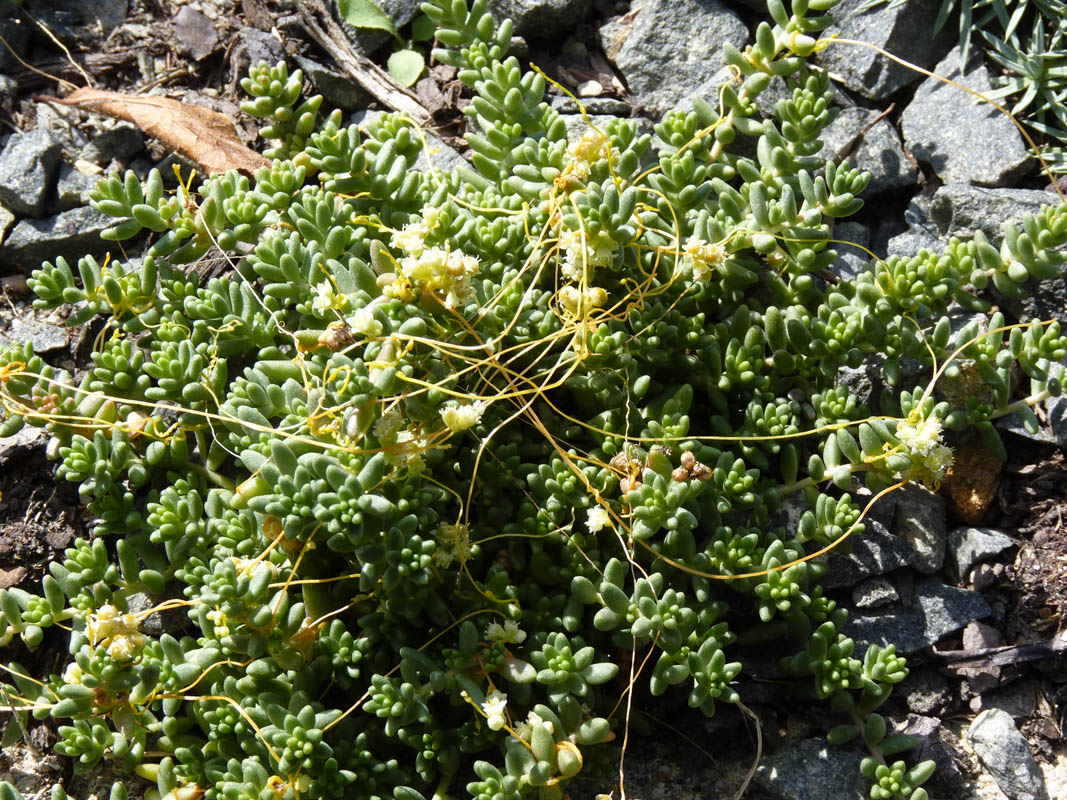
An annual parasitic plant of the Convolvulaceae family, Cuscuta scandens is found in Western and Central Europe, notably in France, Spain, and Portugal. It frequents open environments, moors, roadsides, wastelands, and meadows, generally in plains or hills, where it settles on a wide variety of herbaceous plants and sub-shrubs.
Devoid of chlorophyll, it is incapable of photosynthesis and draws all its resources from its host plants through suckers that it inserts into their conductive tissues. Its thread-like stems, straw-yellow to bright orange, coil and branch into a loose and airy network; the leaves are reduced to tiny scales. The flowers, tiny, cream-white to yellowish, are grouped in small dense glomerules along the stems.
In its natural habitat, its flowering extends from July to September.
Its development is very rapid and spectacular.
Its host spectrum is very wide: sedum, thyme, snapdragon, grasses, and many other herbaceous plants suit it. It may occasionally invite itself into the rock garden and even in pots, without leaving visible damage or offspring, when local climatic conditions are not really favorable to it.