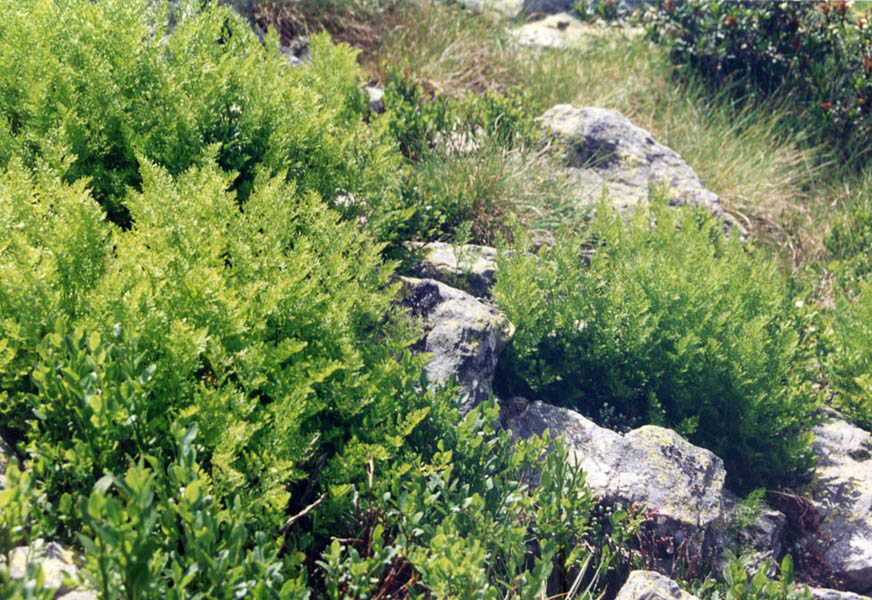
photographed in the Pyrenees
photographed in the Pyrenees
Perennial fern of the Pteridaceae family, Cryptogramma crispa is a circumboreal species found in Central and Northern Europe, in the Alps, the Pyrenees, the Carpathians, the British Isles, and as far as Central Asia. It is absent from low Mediterranean regions and strictly favors mountainous environments, between 1,500 and 3,000 meters in altitude depending on the ranges.
It colonizes acidic screes and rockfalls, fissures of siliceous rocks, moraines, and block accumulations, in sites with prolonged snow cover, well-drained on the surface but cool in depth. It is a faithful indicator of siliceous substrates at altitude.
The plant forms small dense clumps of 10 to 25 cm, with a characteristic bright green. It produces two distinctly different types of fronds: the sterile fronds, with rounded and toothed leaflets, reminiscent of finely cut parsley, and the fertile fronds, more upright and taller, with narrow segments rolled upon themselves, protecting the sori under their reflexed margins. This striking dimorphism is one of the most distinctive traits of the species.
In its natural habitat, sporulation extends from July to August.
In cultivation, it requires an acidic, sandy, very well-drained soil, in a cool exposure; it poorly tolerates calcareous soils and prolonged summer heat.