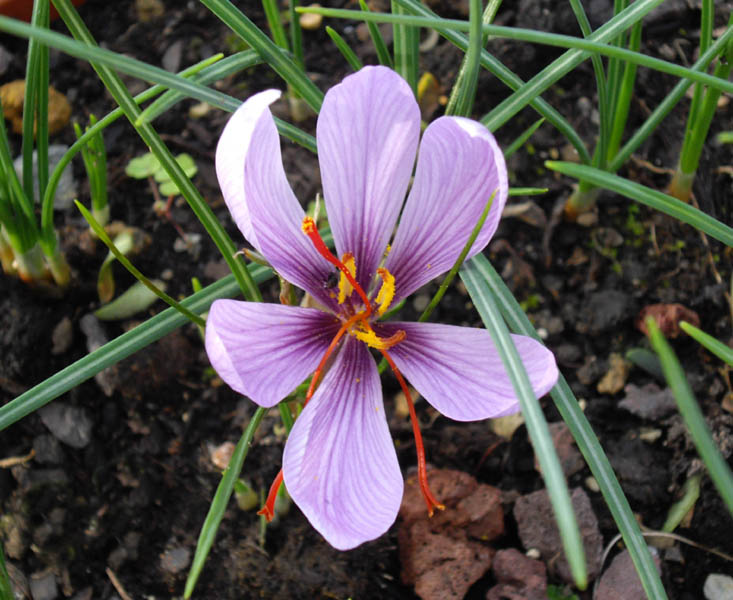
Bulbous perennial of the Iridaceae family, Crocus sativus is a plant of uncertain origin, probably selected and fixed by humans from wild Mediterranean or Middle Eastern species, and cultivated since antiquity throughout the Mediterranean basin, in Central Asia and Iran. It only reproduces by division of its corms, being sterile, and is therefore no longer found in a truly wild state.
It is the saffron plant: its three bright orange-red, long and filiform stigmas are hand-harvested in autumn, dried, and constitute the most expensive spice in the world by weight. About 150 flowers are needed to obtain one gram of dry saffron. This peculiarity makes it one of the most anciently documented cultivated plants, mentioned in Egyptian, Greek, and Persian texts.
The flowers, appearing in autumn before or with the leaves, are lilac to medium violet, elegantly veined with darker violet, with a bright yellow heart. The leaves are narrow, linear, dark green with a white median line, and fully develop after flowering.
In its natural habitat and in cultivation, flowering extends from October to November. It requires well-drained, light soil, in full sun, with a hot and dry summer to bloom generously.