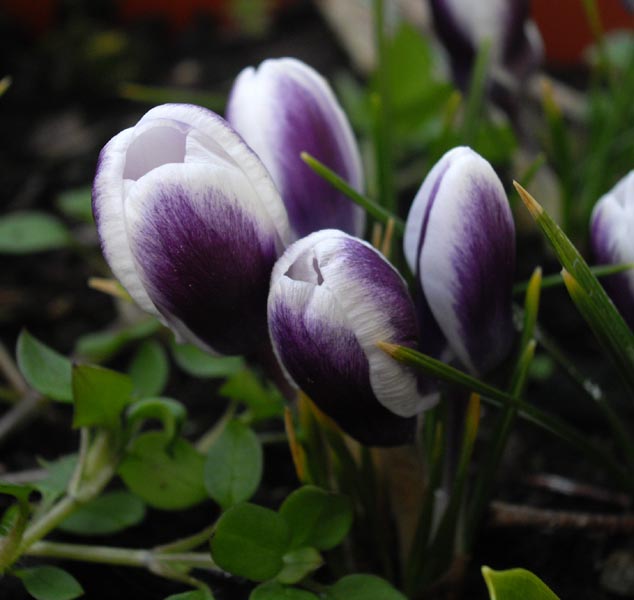
A bulbous perennial of the Iridaceae family, Crocus chrysanthus is a species native to the Balkans, Turkey, and the Caucasus, where it occupies high-altitude meadows, rocky slopes, and open pastures, generally between 1,000 and 2,500 meters. The cultivar 'Prinz Claus' is a horticultural selection obtained in the Netherlands, a country that provided most of the cultivars of this species during the 20th century.
The flowers are white, broadly open, with a deep purple-violet base of the inner tepals forming a very distinct contrasting spot at the heart of the flower. The outer tepals bear dark purple to violet markings on their dorsal side, creating a striking bicolor effect when the flowers are half-closed. The stamens are bright yellow, the stigmas orange. The leaves, narrow and linear, dark green with a white median line, appear simultaneously with the flowers.
In its natural habitat, the species blooms from February to April depending on altitude. In cultivation, 'Prinz Claus' generally blooms from February to March, among the earliest of the spring crocuses.
It requires well-drained, light soil, in full sun exposure, with a dry summer rest. It is well-suited to cultivation in rock gardens, containers, or at the edge of a bed with a mineral substrate, and propagates by separating the corms after a few years.