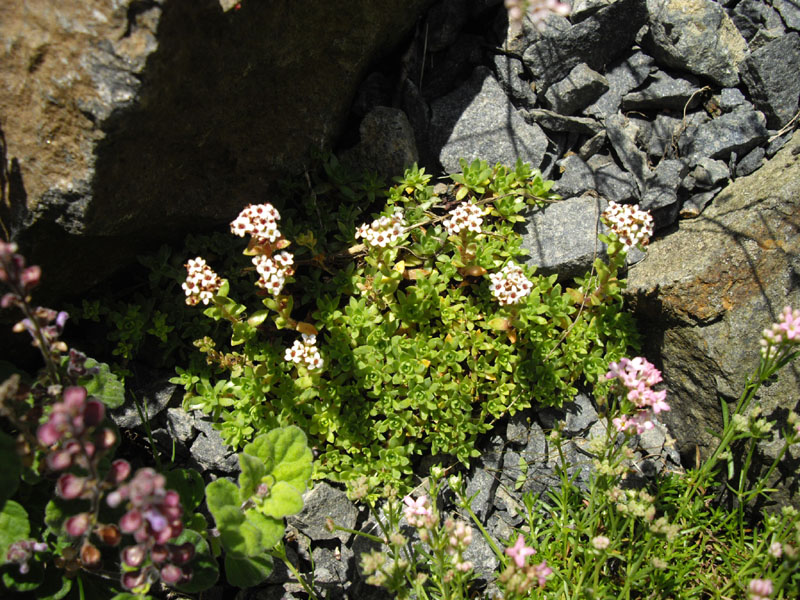
Succulent perennial of the Crassulaceae family, this cultivar is derived from a form of Crassula setulosa native to the high mountains of Lesotho and South Africa, where the species grows in rock crevices and on the rocky ledges of the Drakensberg, at high altitudes often exceeding 2,500 meters. This horticultural selection, among the most appreciated of the genus for alpine cultivation, is distinguished by its particular compactness and vigor.
It forms very tight, hemispherical rosettes, a deep green turning to red-bronze in full sun or cold weather, which multiply slowly to form dense cushions 5 to 8 cm in height. The leaves, fleshy and spatula-shaped, are edged with fine stiff cilia characteristic of the setulosa group, visible under a magnifying glass.
The flowers are star-shaped, pure white barely tinged with pink, borne on thin upright stems that rise slightly above the rosettes and illuminate them at the time of flowering.
In its natural habitat, the species blooms in the austral summer. In cultivation under our latitudes, it occurs from June to August.
In cultivation, it requires full sun, a very well-drained mineral substrate, and rigorous protection against winter moisture. It is particularly suited to alpine troughs, tufa crevices, and sunny rock gardens. Its hardiness reaches about -12 °C in dry conditions.