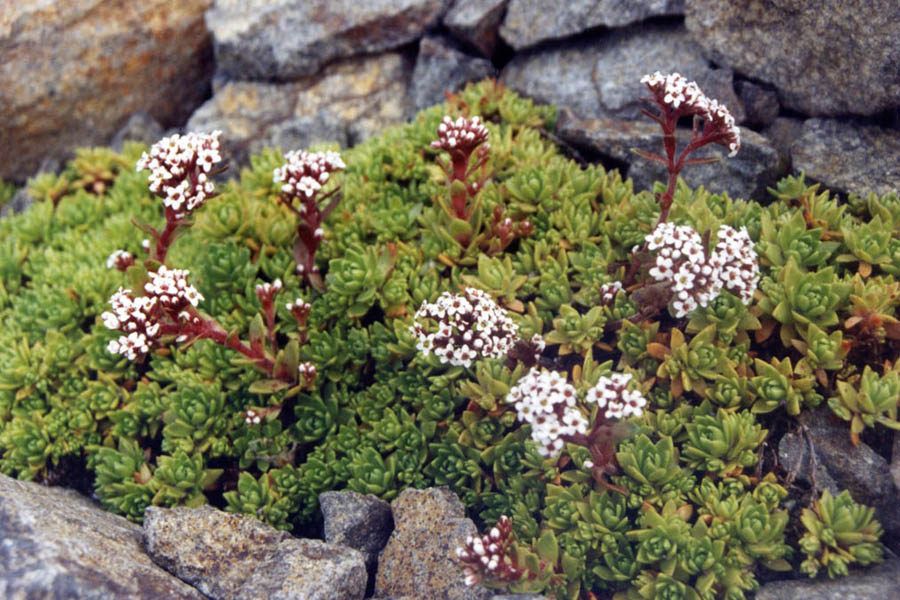
A succulent perennial of the Crassulaceae family, this variety is native to the mountainous regions of South Africa and Lesotho, where it occupies rock crevices, rocky ledges, and exposed granite slopes of the Drakensberg, at altitudes exceeding 2,500 meters. It coexists with other small succulents adapted to the cold and dry conditions of the southern high mountains.
It forms small, low and spreading rosettes, 5 to 10 cm in height, with a dense and compact habit. The leaves are fleshy, spatulate, ciliated on the margins with small stiff hairs that are the distinctive feature of the species, medium green to slightly reddish depending on exposure, arranged in tight rosettes that gradually multiply to form mats.
The flowers are very small, star-shaped, cream-white to pinkish-white, grouped in light cymes carried on slender upright stems emerging above the rosettes.
In its natural habitat, its flowering extends from November to January. In cultivation under our latitudes, it generally occurs from June to August.
In cultivation, it requires full sun, a very well-drained, mineral and poor substrate, and protection from stagnant moisture in winter. It is particularly well suited to trough cultures, wall crevices, and carefully tended alpine rock gardens. Its hardiness, in perfectly drained soil, is estimated around -10 to -12 °C.