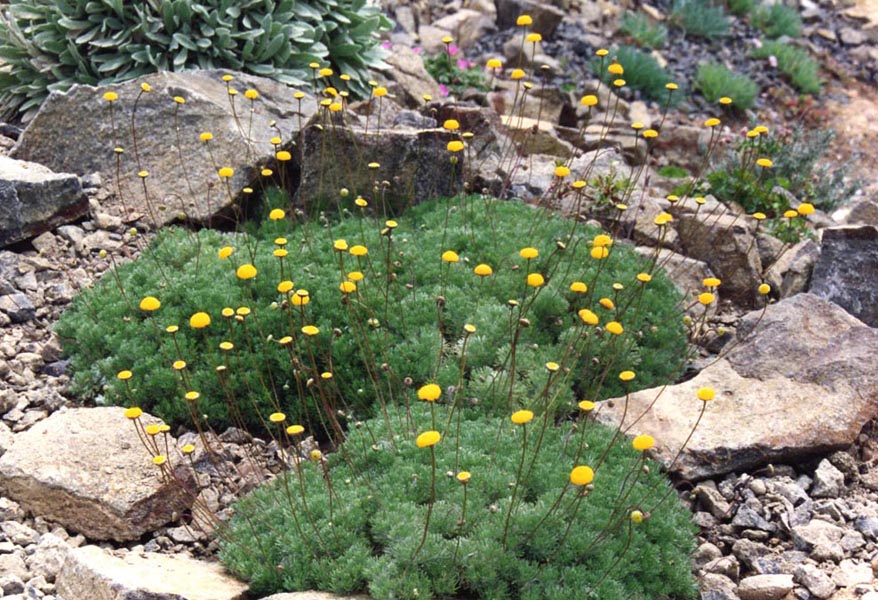
Perennial of the Asteraceae family, this small mat-forming plant is native to South Africa, where it grows in the mountainous areas of the Drakensberg and Eastern Cape, on well-drained rocky substrates, at altitudes that can exceed 2,000 meters. It withstands contrasting conditions, with cold winters and dry, sunny summers.
It forms small, dense, and tight cushions, 5 to 10 cm in height, with a compact and regular habit. The foliage is the most immediately striking feature: the leaves, finely divided into narrow segments, are covered with dense silvery pubescence that gives them a velvety texture and a very bright silvery-gray color, persisting throughout the year.
The flowers are small, bright yellow globular capitula, borne on short upright stems that slightly emerge above the cushion. Their simplicity pleasantly contrasts with the silvery fineness of the foliage.
In its natural habitat, its flowering extends from November to January, in the austral summer. In cultivation under our latitudes, it blooms from May to July.
It requires full sun exposure, a very well-drained, sandy or gravelly soil, and poorly tolerates prolonged moisture in winter. It is perfectly suited for trough rockeries, alpine gardens, and pot cultures under cold shelter for regions with rainy winters. Its hardiness is moderate, around -10 to -12 °C in dry soil.