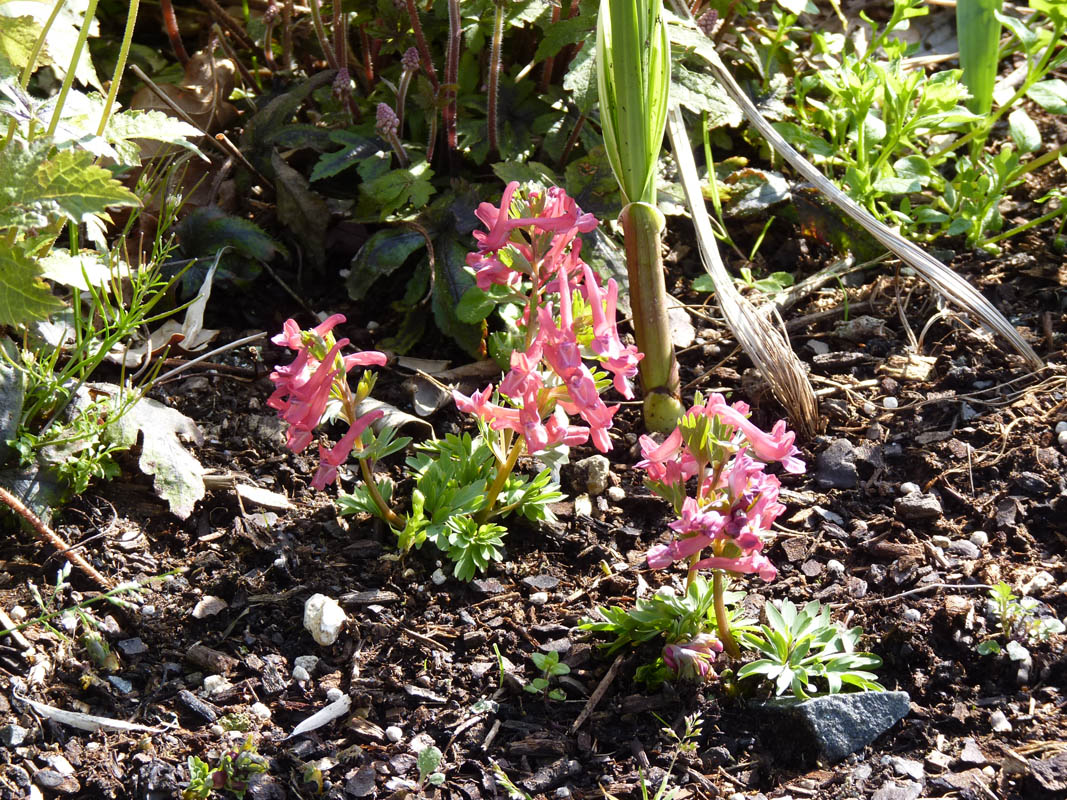
Horticultural selection of Corydalis solida, this tuberous perennial of the Fumariaceae family shares the ecology of the type species: the fresh deciduous woodlands of Europe and temperate Asia, where the tubers enter complete dormancy by late spring. The 'Beth Evans' cultivar was selected for the softness and purity of its floral coloration.
It exhibits the characteristic habit of the group: ephemeral stems of 15 to 20 cm, finely cut glaucous foliage, and total disappearance of the plant after flowering. Nothing signals its presence on the ground during the summer and autumn months.
The flowers are distinguished by a very delicate pale pink to flesh pink hue, almost pearly, with the upper lip slightly more pronounced. The well-stocked clusters have a gentle brightness that differentiates them from the purple and lilac forms of the type species. It is one of the most appreciated selections of the group for the delicacy of its color.
In its natural habitat, the flowering of the type species extends from March to April. In cultivation, 'Beth Evans' blooms from February to April depending on conditions, sometimes very early in the season.
It requires a humus-rich, well-drained soil, fresh in spring and tolerant of summer drought, in partial shade under deciduous trees or shrubs. The tubers are planted in autumn, at shallow depth. It gradually naturalizes by reseeding in favorable conditions.