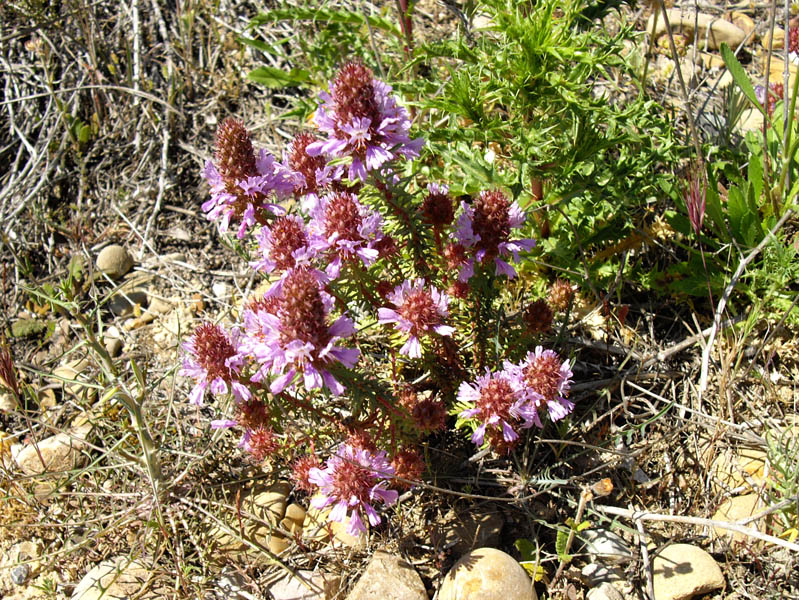
photographed in Spain
photographed in Spain
A short perennial from the Primulaceae family, this subspecies is endemic to the southeast of Spain, where it colonizes arid slopes, open garrigues on limestone, and rocky terrains with almost non-existent soil, in full sun exposure. It is often found in highly disturbed environments, among gravel and rocky slabs, where few plants settle.
It forms small upright tufts, 15 to 30 cm tall, with branched stems bearing narrow, linear, and rigid leaves. What immediately strikes in the field is the striking contrast between the deep reddish-brown calyces and the finely fringed pink-lilac petals: the inflorescence takes on a bicolored and bristly appearance, almost exotic for a garrigue plant.
The flowers with unequal and cut petals are tightly packed in dense, cylindrical spikes, with the prominently protruding stamens accentuating the airy appearance of each spike. The persistent calyces, reddish at maturity, keep the plant decorative well after flowering. In its natural habitat, flowering extends from May to July.
In cultivation, it requires absolute drainage, a very poor calcareous substrate, and full sun exposure without shade. Sensitive to stagnant winter moisture, it is remarkably resistant to the most severe summer drought.