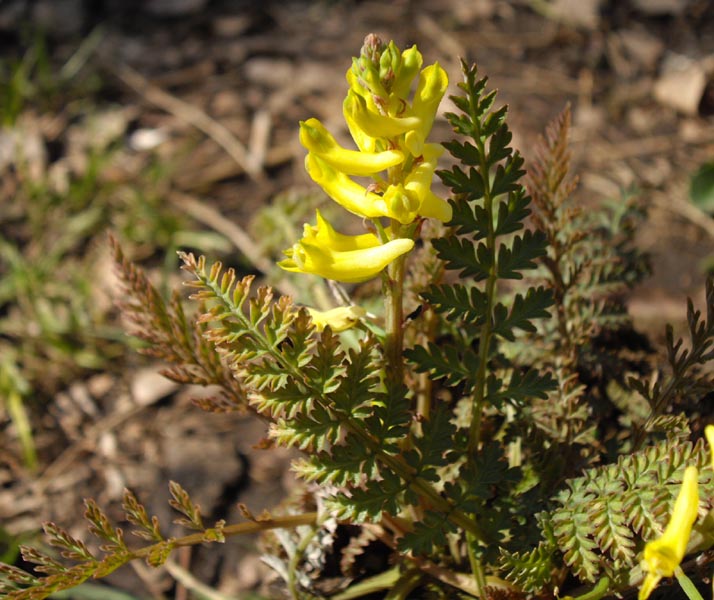
Perennial of the Fumariaceae family (sometimes classified under Papaveraceae depending on classifications), this species is native to central and western China, where it naturally grows on shaded rocks, screes, cliffs, and old damp walls, at altitudes between approximately 500 and 2,000 meters.
It forms dense, persistent rosettes, low and spreading, with a height of 20 to 35 cm, with a slightly arched cushion-like habit. The foliage is one of the plant's distinctive features: the leaves, finely cut into narrow segments reminiscent of a fern, are bronze-green with coppery reflections in winter, particularly ornamental outside of flowering.
The flowers, bright yellow, tubular and spurred, are grouped in upright clusters that emerge from the heart of the rosettes in spring. They attract bumblebees, the only insects capable of accessing the nectar.
In its natural habitat, its flowering extends from April to June. In cultivation, it can start as early as March and continue until May depending on the climate.
It appreciates well-drained, humus-rich, and slightly cool soil, in shade or partial shade. Hardy and generous in spontaneous seedlings, it readily settles in the crevices of walls and shaded rockeries.