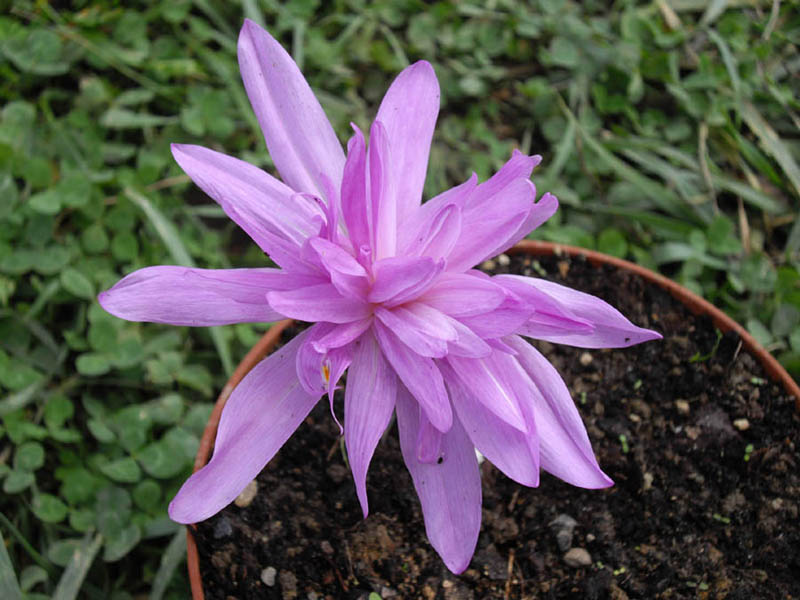
Bulbous perennial of the Colchicaceae family, this horticultural cultivar is one of the most singular of the genus. It is generally attributed to complex crosses involving several species, and stands out radically from other colchicums by the structure of its fully double flowers, which earned it its evocative name.
The flowers, of a deep lilac pink to purplish pink, are composed of numerous tepals arranged in several tight rows, forming a dense and rounded corolla that indeed recalls the flower of a half-open water lily. This unusual floral architecture for the genus is its most immediately striking feature. The flowers are heavy and voluminous, borne directly at ground level by the perigonial tube, without leafy stems, in autumn. Due to their weight, they tend to lie down in rain or wind. The foliage, broad and bright green, appears in spring.
In cultivation, flowering occurs in September-October. Like all species and cultivars of the genus, the plant is toxic in all its parts.
It requires well-drained soil, a sunny to slightly shaded exposure, and benefits from a somewhat sheltered location to protect its heavy flowers from the elements. Its uniqueness makes it a choice subject for collectors and lovers of autumn bulbous plants.