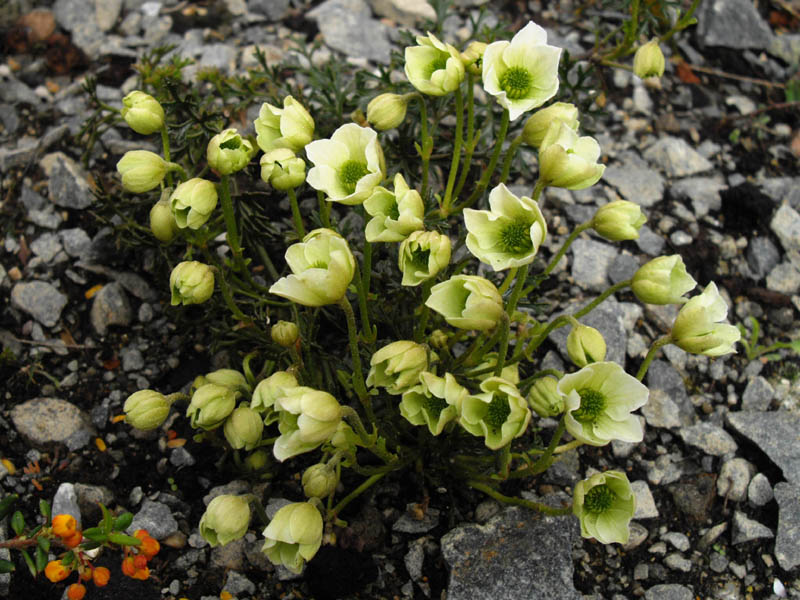
Perennial dwarf shrub of the Ranunculaceae family, Clematis x marmoraria refers in horticultural trade to a hybrid derived from Clematis marmoraria, the endemic New Zealand species, crossed with another small-sized clematis, most often Clematis paniculata, also native to New Zealand. The exact parentage varies according to breeders and is not always specified, which explains why the plant is often sold without further indication than this hybrid name.
The habit is cushion-like to semi-cushion-like, more vigorous than that of the type species, hardly exceeding 15 to 20 cm in height for a progressive spread. The evergreen foliage, very finely divided into linear and stiff segments, forms tufts with a bristly and lively appearance, of a shiny green. The flowers, abundantly borne on short upright peduncles, open widely in a star-shaped cup; their creamy white to pure white tepals surround a compact center of bright green carpels, a characteristic well inherited from C. marmoraria. Flowering in cultivation under our latitudes generally occurs in March-April, sometimes as early as late February in mild conditions.
After flowering, the fruit heads constitute a second quite original decorative moment: the persistent styles, elongated and upright, form spherical heads bristling with bright green, very different from the feathery and silvery aigrettes of large climbing clematis. This bristly, almost mineral aspect naturally harmonizes with the rock garden environment.
Its cultivation requires perfect drainage, a well-aerated mineral substrate, preferably calcareous or enriched with gravel, and a sunny exposure. It tolerates winter humidity better than the pure type species, while remaining sensitive to stagnant water at the collar. A very draining rock garden or an elevated container suits it perfectly.