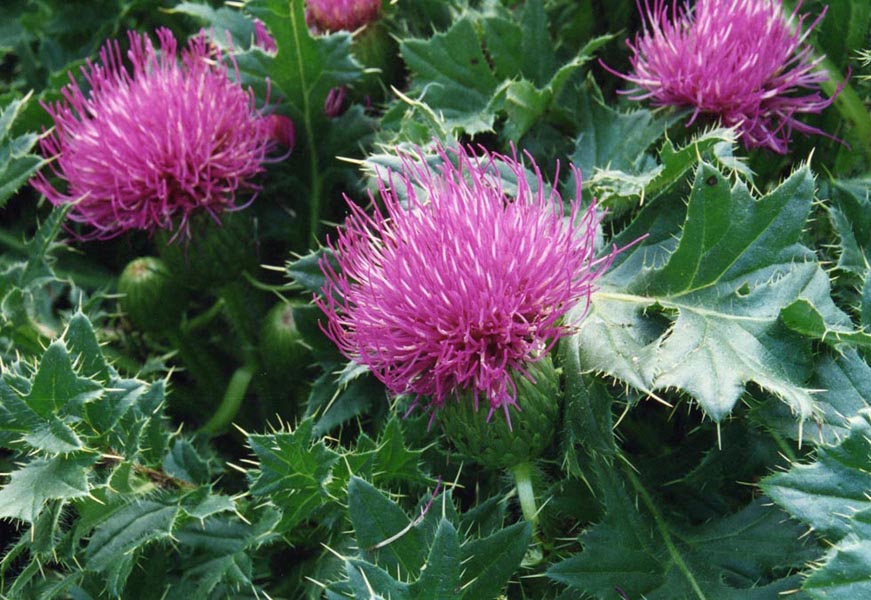
A perennial of the Asteraceae family, this species is widespread in Central and Western Europe, from the British Isles to the Balkans, with a strong presence in mid-mountain regions. It colonizes dry to semi-dry calcareous grasslands, grazed poor meadows, sunny slopes, and open edges, generally between 400 and 2,000 meters in altitude. It favors well-drained calcareous substrates and poor soils kept short by grazing or mowing.
Its most immediately striking feature is its acaulescent or almost acaulescent habit: the plant develops virtually no stem, and the flower heads, often solitary, seem to arise directly from the heart of the basal rosette, lying flush with the ground. The leaves are deeply pinnately lobed, with lobes equipped with robust spines, medium to dark green, arranged in a spreading rosette and pressed against the substrate.
The flower heads are relatively large for the size of the plant, with bright purplish-pink to carmine pink tubular flowers, surrounded by a well-developed involucre with tightly packed spiny bracts. This contrast between the vividly colored flower and the absolutely prostrate habit constitutes the visual signature of the species.
In its natural habitat, its flowering extends from July to September.
In cultivation, it requires a calcareous, dry to moderately drained soil, in full exposure. Little cultivated but remarkable in naturalistic rock gardens on calcareous substrate, it readily attracts butterflies and bumblebees.