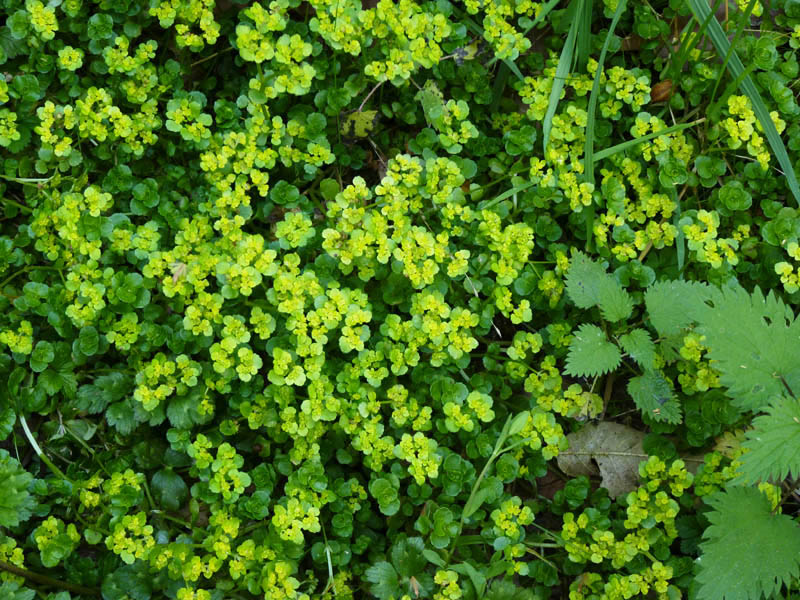
photographed in Chalosse
photographed in Chalosse
Perennial of the Saxifragaceae family, this species is widely spread in Western and Central Europe, from the Iberian Peninsula to the British Isles and Central Europe, with a strong presence in France, Belgium, and the Atlantic regions. It occupies humid undergrowth, stream banks, rocky seepages, springs, and shaded banks, generally at low and medium altitudes, but sometimes rising up to 1,800 meters in mountain ranges.
It forms creeping and dense carpets, only 5 to 15 centimeters high, spreading by stolons to quickly colonize fresh and shaded substrates. The leaves are opposite, small, rounded to kidney-shaped, crenate, of a tender green and slightly fleshy, which gave the species its name. The foliage remains discreet but forms a regular and neat carpet.
The flowering is unique: the flowers are tiny, petal-less, with bright yellow-green sepals, grouped in small cymes surrounded by leaf-like bracts of the same hue that invade the plant at the time of anthesis, giving it a characteristic and easily recognizable golden-greenish coloration.
In its natural habitat, its flowering extends from March to May.
It requires constantly moist to waterlogged soil, rich in humus, in shade or dense shade; it cannot tolerate drought or full sun. It is suitable for humid undergrowth gardens, the edges of water bodies, and natural compositions in a cool and forest-like setting.