syn. Chrysanthemum crassifolium
syn. Chrysanthemum crassifolium
A perennial of the Asteraceae family, this subspecies is endemic to the Cantabrian Mountains in northern Spain, where it occupies mountain meadows, rocky lawns, and grassy slopes on siliceous or calcareous substrates, generally between 800 and 2,000 meters in altitude. It is distinguished from the type species by its particularly thick and leathery leaves, a characteristic that earned it the synonym Chrysanthemum crassifolium.
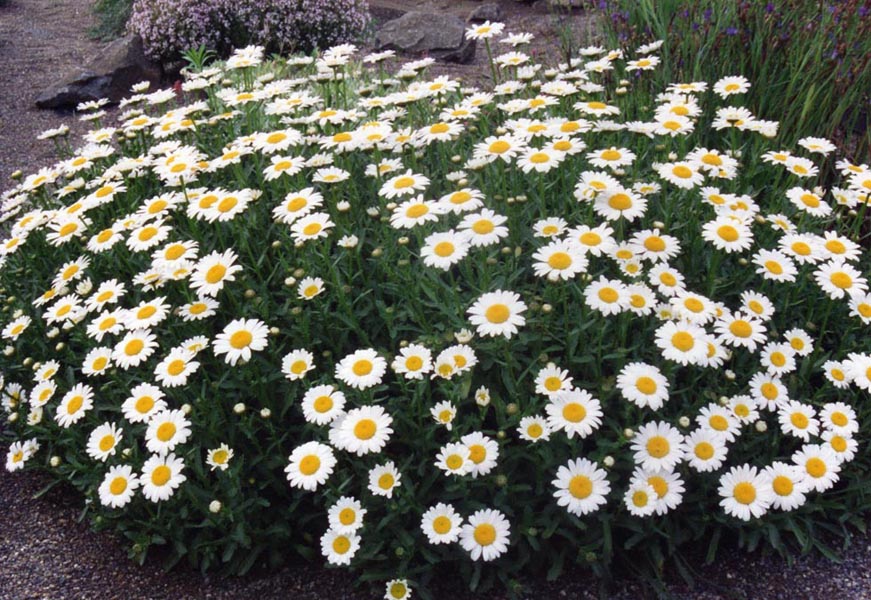
It forms dense, vigorous, and well-rounded clumps, reaching 30 to 50 centimeters in height, remarkably compact at the time of full bloom. The stems are erect, bearing lanceolate to spatulate leaves, deep dark green and glossy, with crenate edges. It is precisely this dark and dense foliage that highlights, by contrast, the brilliant whiteness of the numerous flower heads that almost entirely cover it.
The flowers are classic daisies with pure white ligules arranged around a bright orange-yellow central disc, but their abundance and regularity on such a well-structured clump constitute the most immediately striking feature of the plant, as evidenced by the photograph.
In its natural habitat, its flowering extends from June to August. In cultivation, it often begins in May and can continue until September if the faded flower heads are regularly removed.
It thrives in full sun, in ordinary well-drained soil, not too rich. Hardy and undemanding, it is suitable for both large rock gardens and natural borders and mountain-style gardens.