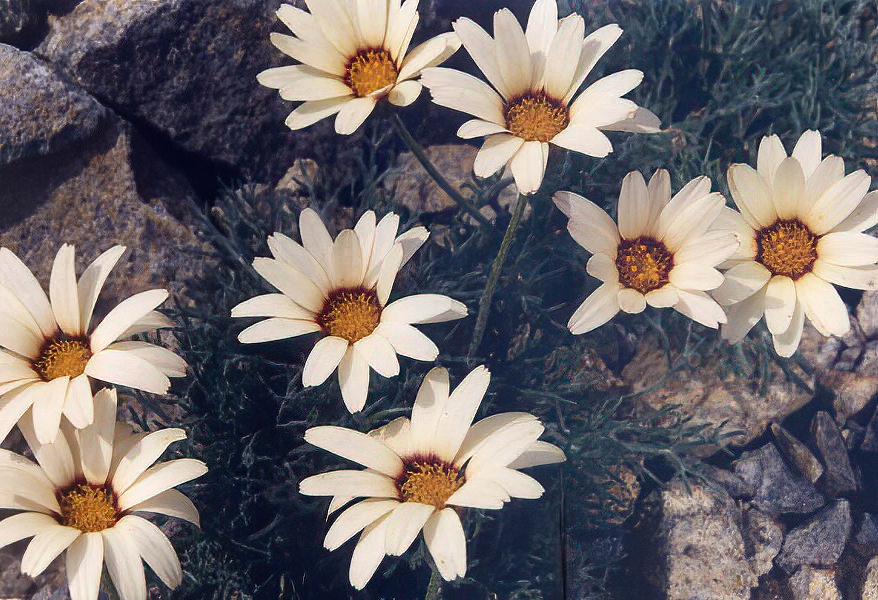
syn. Chrysanthemopsis catananche
syn. Chrysanthemopsis catananche
Perennial of the Asteraceae family, this species is endemic to Morocco, where it is strictly localized to the mountainous massifs of the High Atlas and Anti-Atlas. It occupies the cracks of limestone rocks, cliffs, and rocky scree in sunny exposure, generally between 1,500 and 3,000 meters of altitude.
It forms small cushions or low and compact tufts, woody at the base, reaching 10 to 25 centimeters in height. The leaves are finely cut, pinnatisect, silver-gray to gray-green, densely covered with a silky indumentum that gives them a downy appearance and constitutes one of the ornamental qualities specific to this species, regardless of flowering.
The capitula, borne singly on slender peduncles, are remarkably large relative to the size of the plant. The ligules are pure white to slightly pinkish, often tinged with lilac on the reverse, and surround a bright yellow central disc. The bracts of the involucre have well-visible brown scarious margins, reminiscent of those of catananches, which inspired the specific epithet.
In its natural habitat, its flowering extends from May to July. In cultivation, it can bloom as early as April and continue until August with a warm and well-drained exposure.
It requires perfect drainage, a poor mineral substrate, preferably limestone, and full sun exposure. Sensitive to excess winter moisture, it is advantageously cultivated in pots or wall crevices in regions with rainy winters.