syn. Saxifraga cotyledon var pyramidalis
syn. Saxifraga cotyledon var pyramidalis
Perennial of the Saxifragaceae family, this variety is confined to the mountainous massifs of Western Europe, from the Pyrenees to the Scandinavian Alps, where it colonizes the fissures of siliceous rocks, seeping granite walls, and humid cliffs, generally between 800 and 2,200 meters in altitude. It is one of the most spectacular saxifrages in its natural expression.
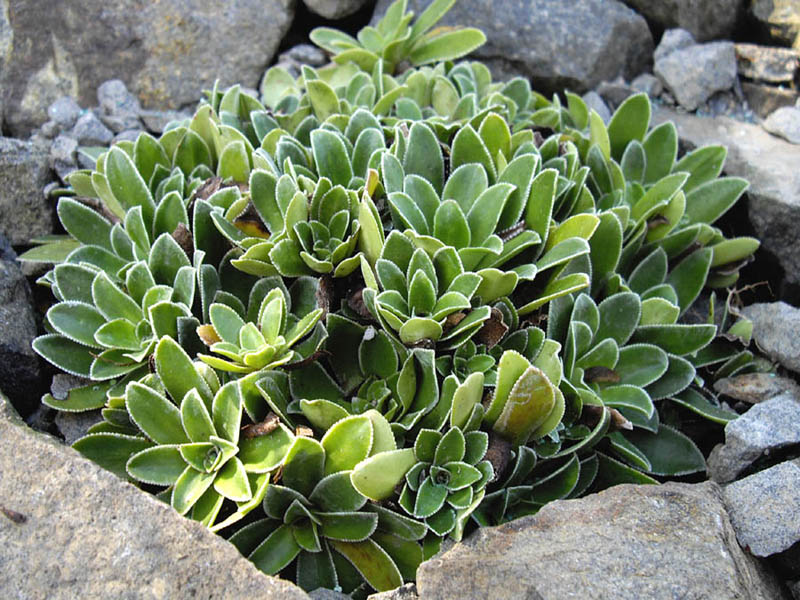
It forms large, dense, and regular rosettes, from medium green to bright green, with spatulate, thick, and leathery leaves, whose margins are finely crenellated and encrusted with whitish calcareous deposits secreted by hydathodes. These light encrustations on the leaf edges are one of the most easily observable and distinctive features of the plant.
The variety pyramidalis is distinguished from the typical form by its particularly ample and architectured inflorescence, in an elongated pyramidal panicle that can reach 30 to 60 centimeters in height, bearing numerous small white flowers with petals slightly dotted with red at their base, arranged in gradually decreasing lateral clusters that outline a distinctly pyramidal silhouette.
In its natural habitat, its flowering extends from June to August. In cultivation, it generally occurs from May to July depending on exposure and altitude.
It requires a well-drained substrate, fresh to slightly humid, rich in gravel, preferably in a north or northeast exposure to preserve root freshness. It is perfectly suited to dry stone walls, vertical fissures, and shaded alpine gardens.