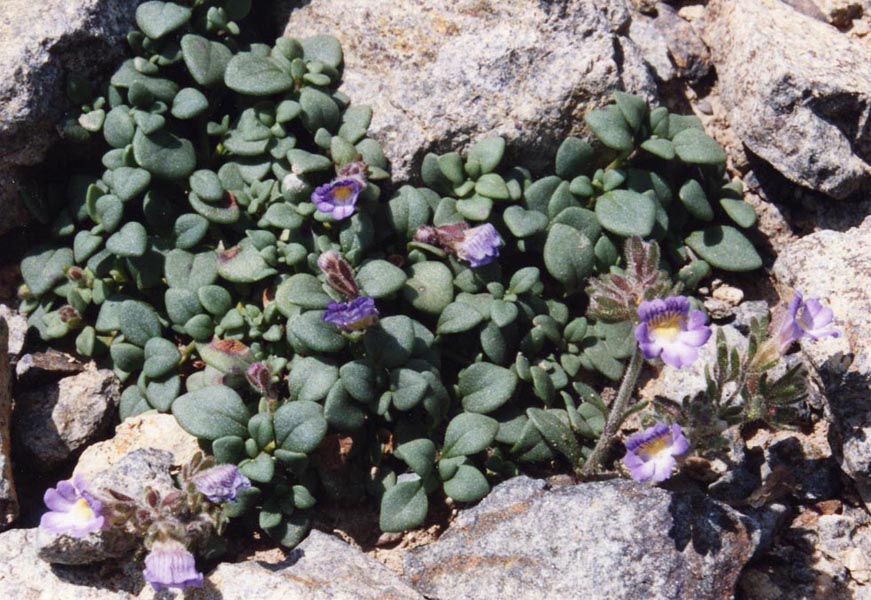
- photographed in the Pyrenees -
- photographed in the Pyrenees -
Perennial of the Plantaginaceae family, Chaenorrhinum origanifolium is a species from the mountains of southwestern Europe, present in the Pyrenees, northern Spain, and the Massif Central, where it colonizes rock fissures, scree, and sunny rock slabs, generally between 1,000 and 2,500 meters in altitude. The 'Pyrénées' cultivar corresponds to a selection with a particularly compact habit and abundant flowering.
The plant forms a dense, mat-forming cushion, barely 5 to 10 centimeters high, with slightly pubescent thin stems. The leaves are small, oval to suborbicular, fleshy, with a glaucous green to blue-green color, resembling in shape those of oregano, which the specific epithet recalls. The stems and flower buds often take on brown-purple hues in full sun, as can be clearly seen in the photographs.
The flowers are of a reduced linaria type, bilabiate, a bright lilac-purple to purple, with a well-visible pale yellow palate that guides pollinators. They are produced in very large quantities and practically cover the foliage at the peak of flowering.
In its natural habitat, flowering extends from June to August depending on the altitude. In cultivation, it can start as early as May and continue until September with a light trim after the first flush.
It requires a very well-drained, mineral substrate, in full sun, and tolerates summer drought well once established. It integrates perfectly into wall crevices and alpine rock gardens.