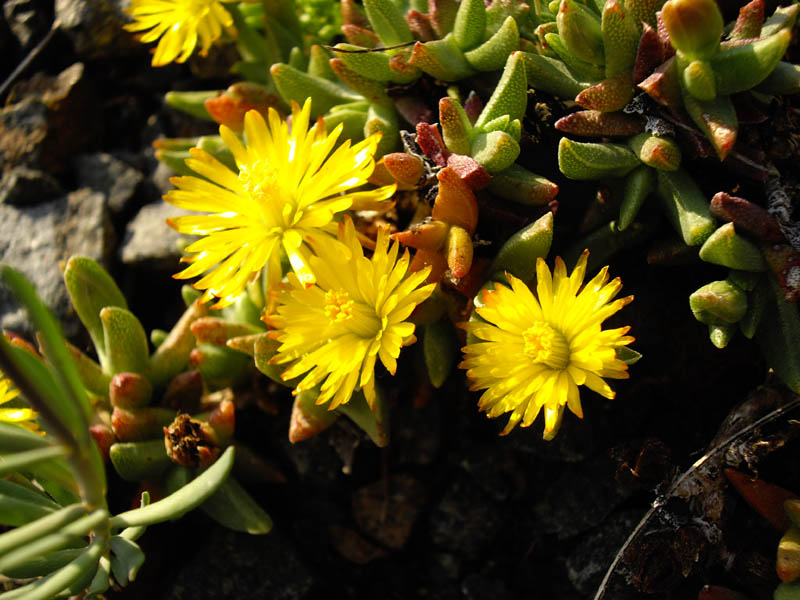
A perennial succulent from the Aizoaceae family, this species is native to South Africa, where it is confined to the semi-arid regions of Namaqualand and the Karoo. It grows in quartzitic or granitic rock crevices, on sandy and very poor substrates, in sunny exposure, at modest altitudes.
It forms small, dense, compact cushions, reaching 5 to 10 centimeters in height for clumps that can spread over 20 to 30 centimeters. The leaves are succulent, triquetrous, short and stocky, with a glaucous green to gray-green color, arranged in tight rosettes that fit into very dense clumps. Their slightly rough surface and ashy hue give them a mineral appearance that naturally blends into its rocky environment.
The flowers are solitary, large relative to the size of the plant, with numerous narrow and radiating petals of bright yellow to golden yellow, reminiscent of the structure of a very tight daisy. They open in full sun and close at night, a typical characteristic of the family.
In its natural habitat, its flowering occurs mainly in autumn and winter, following the winter rainfall regime of Namaqualand. In cultivation under our climates, it generally blooms from late summer to autumn.
It requires perfect drainage, a very mineral substrate low in organic matter, and full sun exposure. It tolerates light and brief frosts provided it is kept dry in winter. Its cultivation in pots or containers with coarse sandy substrate is particularly suitable under climates with wet winters.