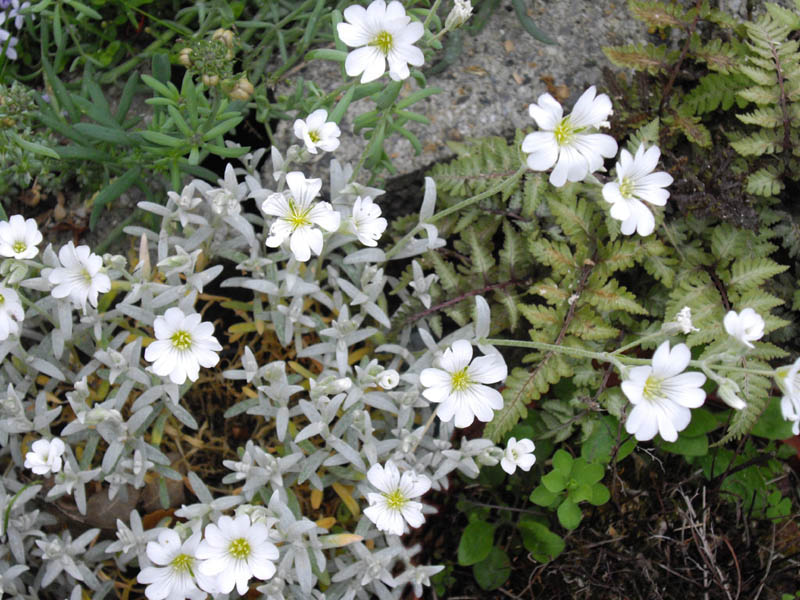
A perennial from the Caryophyllaceae family, Cerastium tomentosum originates from the mountains of central and southern Italy, notably the Apennines and Sicily, where it colonizes rocks, screes, and dry alpine meadows. Widely naturalized in Europe and North America, it is now one of the most widespread rock garden ground covers in cultivation.
It forms dense and vigorous mats, spreading widely, from 10 to 20 centimeters in height, capable of covering large areas in a few seasons. Its most immediately striking feature is its intensely silvery-white foliage, due to a very dense woolly tomentum that entirely covers leaves and stems. The leaves are narrow, linear to lanceolate, giving the plant an almost mineral appearance, similar to certain artemisias or Antennaria.
The flowers are pure white, with five deeply bilobed petals, borne in abundant cymes above the foliage. As with Cerastium arvense, the flowering is very generous and can entirely mask the silvery mat under a veil of dazzling white.
In its natural habitat, flowering extends from May to July. In cultivation, it generally occurs in May-June.
It thrives in full sun, in any well-drained soil, including poor and dry. It tolerates heat and summer drought well, but can become invasive in favorable conditions; pruning after flowering helps contain its spread and refresh the foliage.