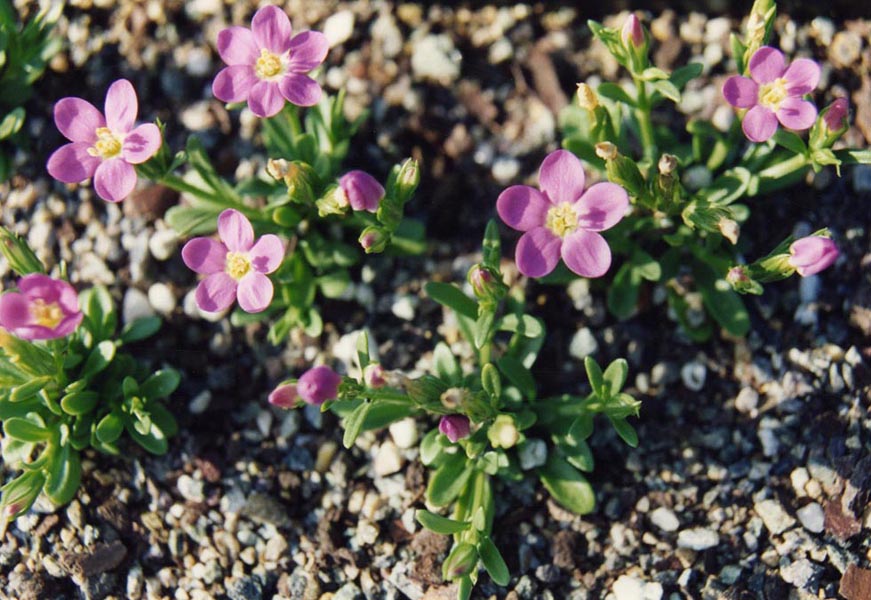
Perennial of the Gentianaceae family, Centaurium scilloides is clearly distinguished from its annual counterparts by its perennial nature and its prostrate habit in dense cushions. Its natural range is Atlantic and disjointed: western coasts of the Iberian Peninsula, Armorican Brittany, Wales, and the Azores. It occupies short grasslands on acidic soils, coastal heaths, grassy cliffs, and coastal rocks battered by sea winds, generally at low altitude.
The plant forms small, tight mats 5 to 10 cm in height, with creeping stems emitting short, erect flowering branches. The leaves are small, oval to elliptical, opposite, bright green, and slightly fleshy, giving them some resistance to desiccation in exposed environments.
The flowers, with five widely open star-shaped petals, are a bright pink-lilac with a yellowish center; they are borne in small terminal groups and succeed each other over a long period. The photographs well illustrate the contrast between the still closed, whitish to pinkish buds, and the more intense pink open flowers.
In its natural habitat, its flowering extends from June to August. In cultivation, it appreciates full sun, well-drained, slightly acidic soil, not too rich; it is perfectly suited to Atlantic character rock gardens and culture pots in sunny exposure.