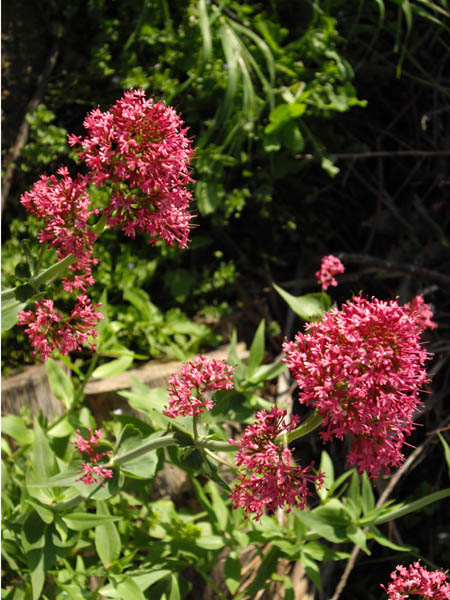
A perennial from the Caprifoliaceae family, Centranthus ruber originates from the Mediterranean basin, from the Iberian and Moroccan coasts to Turkey and Greece. It naturally colonizes limestone cliffs, old walls, rocky screes, and open garrigues, from sea level up to about 1,000 meters in altitude. Naturalized far beyond its original range, it has spontaneously established itself on the walls of many cities in Western Europe.
It forms bushy clumps 40 to 80 cm in height, with erect, glaucous, slightly fleshy stems. The leaves are opposite, oval to lanceolate, with a characteristic bluish-green color, entire or faintly toothed at the base.
The flowers are tiny, tubular, gathered in dense, very full terminal corymbs; their color ranges from carmine red to bright pink, more rarely pure white in some cultivated forms. A well-visible nectariferous spur at the base of the floral tube is one of the species' morphological peculiarities, accessible mainly to long-tongued Lepidoptera.
In its natural habitat, its flowering extends from April to July, sometimes until autumn after a cut. In cultivation, it shows remarkable frugality: full sun, poor and very well-drained soil, preferably limestone; it self-seeds abundantly and finds its natural place at the foot of dry walls and in sunny rock gardens.