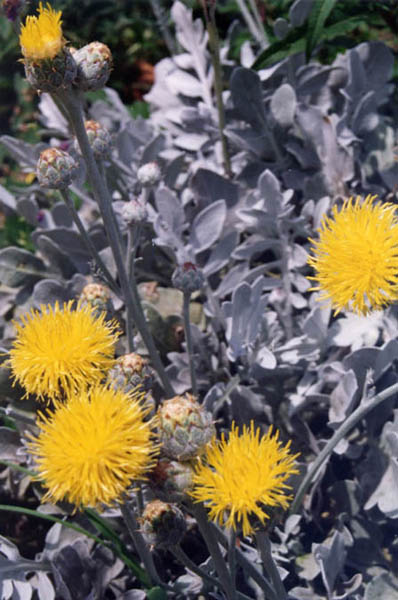
Perennial of the Asteraceae family, Centaurea ragusina is an endemic species of the Dalmatian coast, in Croatia, where it naturally grows on maritime cliffs, limestone rocks, and coastal screes battered by wind and salt, at low altitude. Its original area is closely located around Dubrovnik, whose old Latin name, Ragusa, gave it its epithet.
It forms dense and spreading clumps, bushy, 30 to 50 cm in height, with a very pronounced architectural habit. The foliage is the most striking feature of the plant: the leaves are thick, deeply lobed to pinnatisect, entirely covered with a dense, cottony white-silvery tomentum that gives them an almost mineral appearance, perfectly in harmony with the limestone rocks it inhabits.
The flower heads, borne on long slender stems rising above the foliage, are a bright and clear yellow, creating a luminous contrast with the white of the foliage. The tubular flowers are all similar, without enlarged peripheral ligules.
In its natural habitat, its flowering extends from May to July. In cultivation, it blooms from May to June and shows great resistance to heat, drought, and wind. It requires full absolute sun and impeccable drainage; it does not tolerate stagnant moisture in winter. Excellent plant for dry rock gardens, Mediterranean gardens, and containers in regions with mild winters.