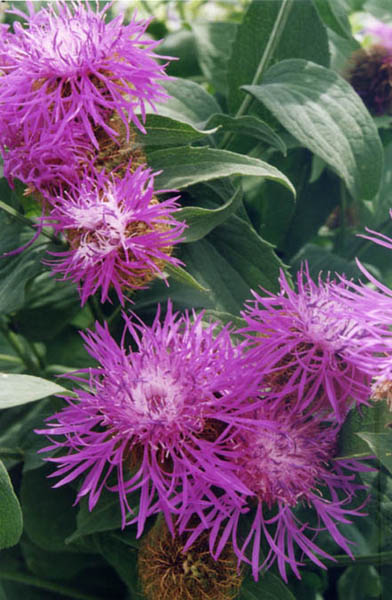
Perennial of the Asteraceae family, Centaurea phrygia is a species widely distributed across Central and Eastern Europe, from the Eastern Alps to the Baltic countries and Western Russia, with isolated populations in the Balkans and the Carpathians. It colonizes poor meadows, forest edges, embankments, and semi-open lawns, generally in lowlands and mid-mountains.
It forms upright clumps 40 to 80 cm tall, with sturdy stems, slightly winged and tomentose. The leaves are oval to lanceolate, green above, paler and slightly woolly below. The flower heads are solitary or few at the top of the stems. The involucre is one of the most striking features of the species: its scales bear long pectinate appendages, dark brown to blackish, spread out in a dense brush, giving the flower bud a very distinctive hairy and almost spherical appearance. The flowers are a bright purple-pink, the peripheral ligules radiant and slightly longer than the central flowers.
In its natural habitat, its flowering extends from July to September. In cultivation, it is undemanding: it accepts any well-drained soil, even poor, in the sun or light partial shade, and readily reseeds itself.
Its involucre bristling with dark bristles, contrasting with the bright flowers, makes it an immediately recognizable plant among European knapweeds.