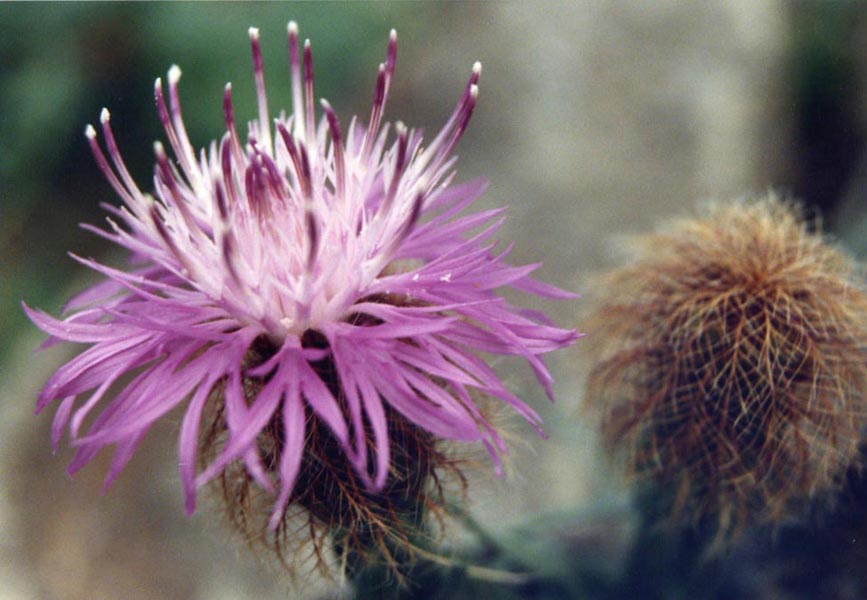
Perennial of the Asteraceae family, Centaurea parilica is a rare species, described in 1923, whose distribution area is centered on northeastern Greece, with mentions in Turkey and Iran. In Greece, it is considered rare and is among the species with a concerning conservation status. It grows on rocky slopes, subalpine lawns, and summits, between 1,000 and 2,200 meters altitude, notably on the Falakro massif where it has been observed at 2,057 meters.
The plant forms low, compact clumps. The leaves are narrow, grayish, with slightly decurrent margins on the stems. The flower heads are solitary and borne on sparsely branched stems. The involucre is particularly remarkable: its scales are densely fringed with brown-red to almost black appendages, giving the bud a very characteristic woolly and bristly appearance. The flowers are a bright lilac-pink to magenta, with well-developed and radiant peripheral ligules.
In its natural habitat, its flowering extends from July to August depending on the altitude. In cultivation, it is not widespread but behaves like a demanding rock garden plant: strict full sun, perfect drainage, poor to rocky soil.