Perennial of the Asteraceae family, Centaurea macrocephala is native to the Caucasus, Armenia, and northeastern Turkey, where it grows in subalpine meadows, grassy slopes, and forest edges at altitude, generally between 1,500 and 2,800 meters. Its epithet, which means "large-headed", clearly announces the most striking feature of the plant.
It forms robust and upright clumps, reaching 80 to 120 cm in height. The stems are thick, sparsely branched, bearing lanceolate to oval leaves, slightly toothed, of medium green, without any particular tomentum.
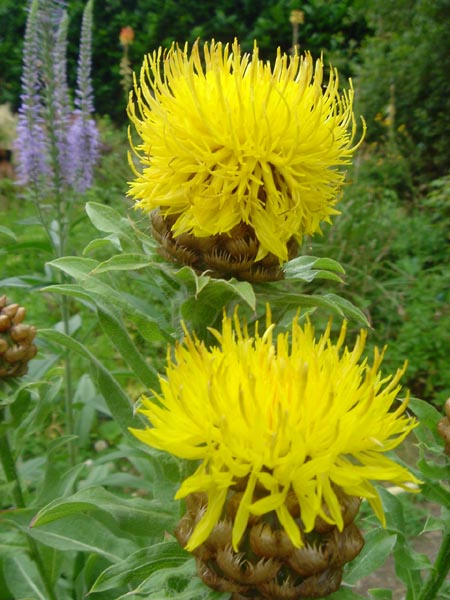
The flower head is truly monumental: solitary at the top of each stem, it can reach 6 to 8 cm in diameter. The involucre is formed of broad, scarious scales, golden to straw-brown, fringed on their margins, which envelop the flower head with a shiny and dry collar, almost evoking an ornamental thistle head even before the flowers open. The tubular flowers are bright yellow, dense and luminous, crowning this golden involucre in a very theatrical manner.
In its natural habitat, flowering extends from July to August. In cultivation, it generally occurs from June to July.
The dried flower heads retain their intact golden involucre and naturally integrate into dry flower arrangements. It thrives in full sun, on well-drained, moderately rich soil, and proves very hardy and durable once established.