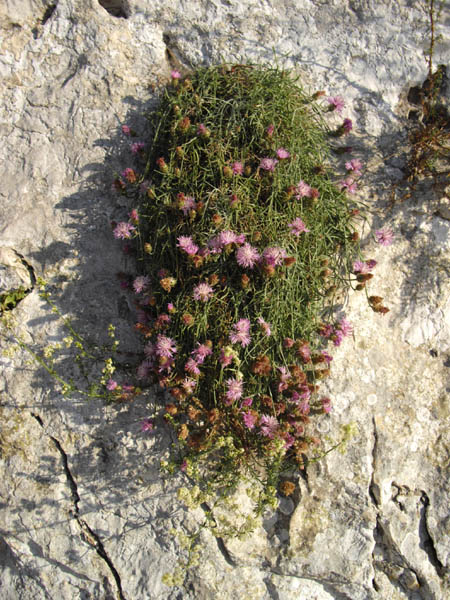
photographed in Spain
photographed in Spain
Perennial of the Asteraceae family, Centaurea aspera is a species from the western Mediterranean basin, present from Portugal and Spain to the south of France, in Italy and North Africa. It willingly colonizes dry and stony grounds, open garrigues and limestone cliffs, from sea level to moderate altitudes.
On rocky walls and ledges, it takes on a dense and spreading cushion shape, with prostrate stems that lengthen and fall freely over the rock according to the available slope. The leaves are very narrow, linear to almost filiform, of a medium green, which gives the whole a fine and tight texture, very different from the roadside forms with wider leaves. The stems and leaves are rough to the touch, a characteristic directly recalled by the Latin epithet aspera.
The flower heads, small and numerous, are borne on short stems; the flowers are pink-lilac to bright pink, and the bracts of the involucre end in well-visible radiating spiny appendages at withering.
In its natural habitat, flowering extends from June to September.
In cultivation, it is content with well-drained, poor soil, in full sun, and easily withstands summer drought. It is suitable for walls, dry rockeries and Mediterranean-style gardens.