A perennial of the Asteraceae family, Celmisia ramulosa is endemic to New Zealand's South Island, where it colonizes scree, rock crevices, and rocky alpine lawns, generally between 1,000 and 1,800 meters in altitude.
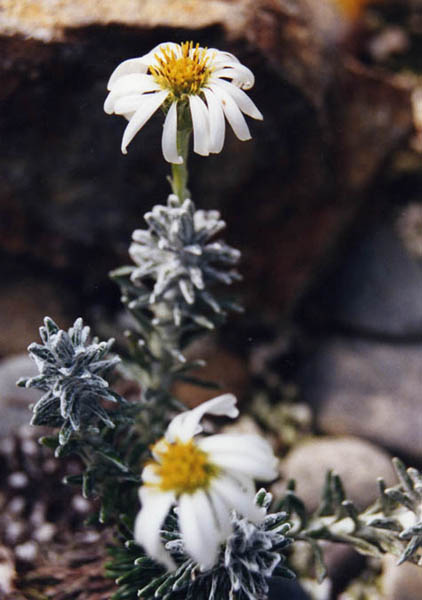
It forms a loose, branched, low cushion, with woody stems at the base bearing short, narrow, mucronate leaves, very densely arranged in terminal star-shaped rosettes. The entire foliage is covered with a dense and uniform silvery tomentum, giving the plant a very characteristic silvery-gray hue, almost mineral, in perfect harmony with the rocks it favors.
The capitula, solitary at the top of slender, erect peduncles, feature narrow white ligules radiating around a bright yellow central disc. This contrast between the pure white of the ligules, the gold of the disc, and the silvery gray of the foliage is one of the most striking visual effects of the genus in alpine environments.
In its natural habitat, flowering extends from December to February. In cultivation under our latitudes, it generally occurs from June to July.
It requires a very well-drained, poor soil, in full light, with winter protection against stagnant moisture. It is suitable for draining rock gardens and well-exposed alpine gardens.