Perennial of the Asteraceae family, Celmisia argentea is native to New Zealand, where it is endemic to the South Islands. It occupies alpine lawns, rocks, and exposed ridges, generally between 1,000 and 1,800 meters in altitude, on well-drained substrates.
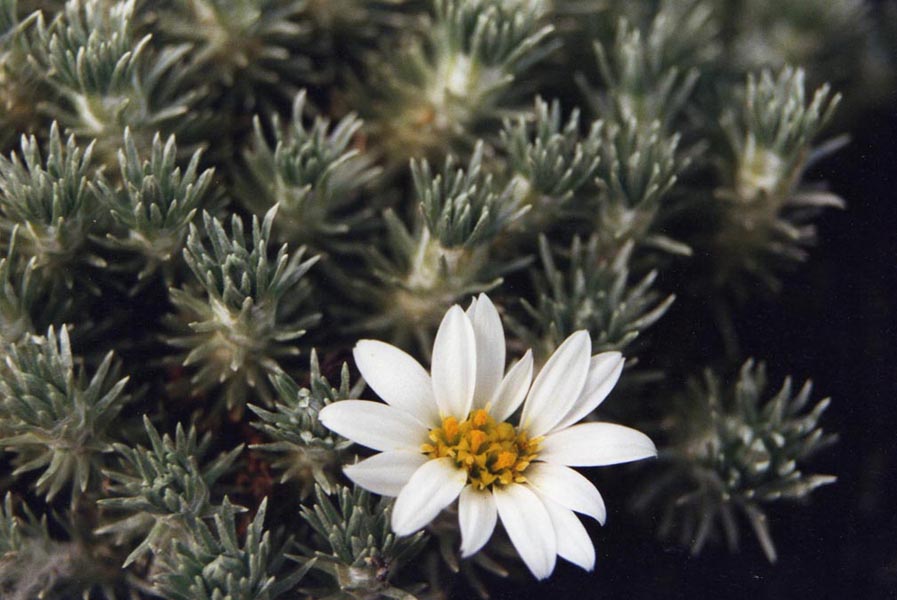
It forms dense, compact, tight, and rigid cushions, hardly exceeding 5 to 10 cm in height. Its foliage is one of its most immediately striking features: the leaves are very small, narrowly linear, densely imbricated, covered with a tight silvery tomentum that gives them this shiny and metallic appearance, which is the origin of the epithet argentea.
The flowers are solitary capitula, white with a yellow heart, borne on short peduncles, typical of the genus. In its natural environment, its flowering extends from December to February, which corresponds to the austral summer. In cultivation in the northern hemisphere, it generally blooms in June-July.
It requires an acidic to neutral, perfectly drained soil, rich in gravel, in a sunny exposure. It poorly tolerates stagnant winter humidity, which is its main threat in cultivation. Protection against prolonged winter rains is recommended.