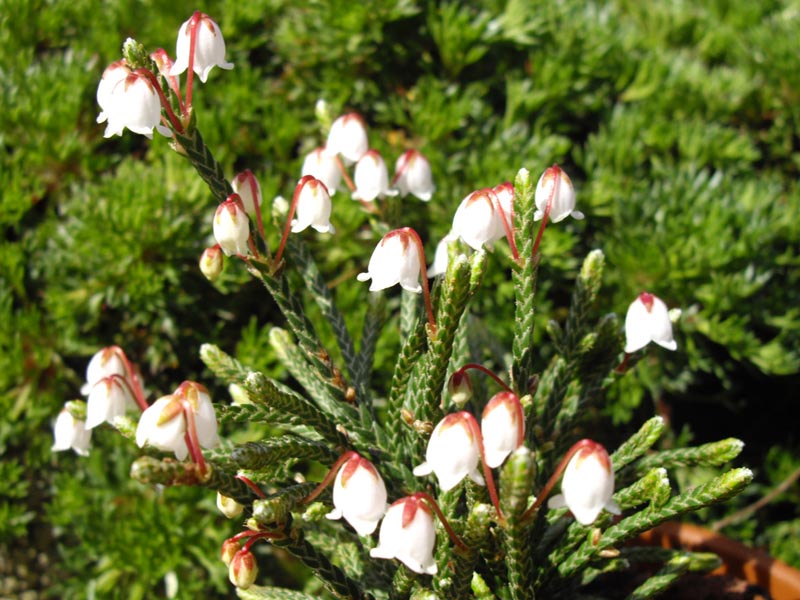
Dwarf subshrub of the Ericaceae family, Cassiope 'Randle Cooke' is a horticultural hybrid whose exact origin remains uncertain, but is generally attributed to a cross involving Cassiope lycopodioides. It is named after a British alpine plant enthusiast, following a well-established tradition in rock gardening circles where the genus Cassiope has always sparked passionate interest.
It has a low and spreading cushion-like habit, dense and regular, barely exceeding 8 to 12 cm in height. The creeping stems are covered with small, dark green scaly leaves, closely overlapping, giving them a corded and compact appearance reminiscent of certain mosses or clubmosses.
The flowers are delicate, pure white bells, hanging on thin peduncles, with a calyx with distinctly pink to reddish-brown sepals that add a welcome touch of color at flowering time. This contrast between the whiteness of the corolla and the strong hue of the calyx is one of the most attractive features of this cultivar. In cultivation, flowering occurs from April to May.
It requires an acidic, humus-rich, and peaty soil, constantly cool, without lime, sheltered from summer heat and drought, in a cool or slightly shaded exposure.