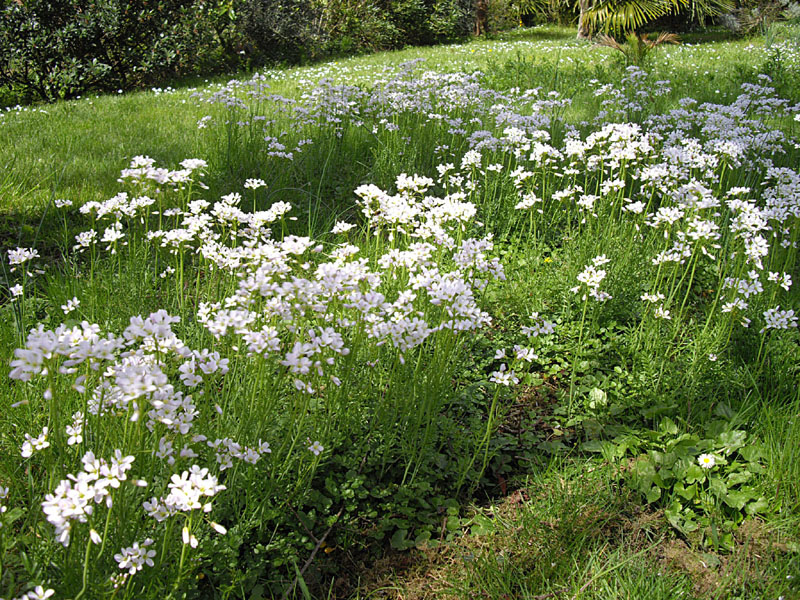
A perennial of the Brassicaceae family, Cardamine pratensis is a circumboreal species widely spread in Europe, temperate Asia, and North America, where it colonizes wet meadows, ditch edges, banks, and marshy areas, from the plains up to about 2,000 meters in mountainous regions.
It forms basal rosettes of pinnate leaves, with rounded leaflets, of a tender green, from which slender, erect stems rise, 20 to 50 cm in height. The cauline leaves have narrower and more numerous leaflets than those of the rosette, giving them a more finely cut appearance.
The flowers are white, sometimes lilac pink to pale pink, with four well-developed petals, gathered in light and elegant terminal clusters. The stamens with yellow anthers contrast pleasantly with the light petals. The plant has a remarkable feature: it can reproduce vegetatively from leaflets fallen to the ground, which emit adventitious plantlets.
In its natural habitat, its flowering extends from April to June. In cultivation, it generally occurs in April-May, with horticultural double forms, notably 'Flore Pleno', which prolong the decorative effect.
It requires a constantly fresh to moist soil, rich in organic matter, in a sunny to semi-shaded position. It is suitable for wet flower meadows, water body banks, and natural gardens where it self-seeds spontaneously.