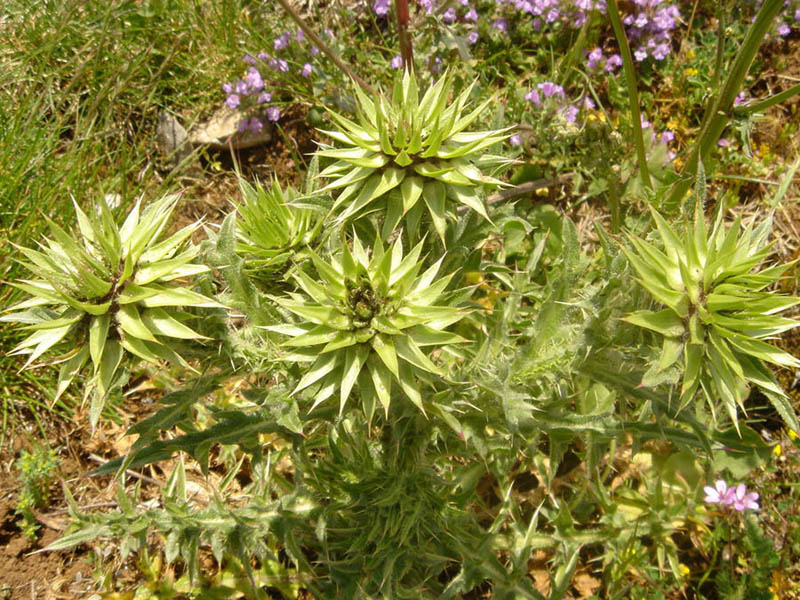
photographed in Spain
photographed in Spain
Biennial or sometimes short-lived perennial, from the Asteraceae family, Carduus nutans is a species with a very wide Eurasian distribution, naturalized on all temperate continents. It occupies dry grasslands, roadsides, wastelands, sunny limestone slopes, and overgrazed pastures, from the plains up to about 1,800 meters altitude.
The plant first forms a large, very spiny basal rosette, with deeply lobed, grayish-green leaves with robust, yellowish spines. The stems are erect, strongly winged and spiny, 40 to 120 cm in height, bearing usually solitary capitula at the end of the branch.
The capitulum is one of the largest of the genus in Europe: globular to hemispherical, it can exceed 5 cm in diameter, often leaning to the side at maturity, hence the name nutans, which means nodding. The flowers are a bright pink-purple, and the involucral bracts are broad, reflexed, and spiny, framing the capitulum with a very characteristic bristly collar.
In its natural habitat, its flowering extends from June to September.
Carduus nutans grows easily on any well-drained soil, preferably calcareous, in full sun, and self-seeds spontaneously.