Perennial of the Asteraceae family, Carduus carlinoides is an endemic thistle of the Pyrenees and the mountains of the northern Iberian Peninsula. It grows on rocky grasslands, scree, and exposed ridges, on calcareous or siliceous substrates, between 1,500 and 2,800 meters in altitude.
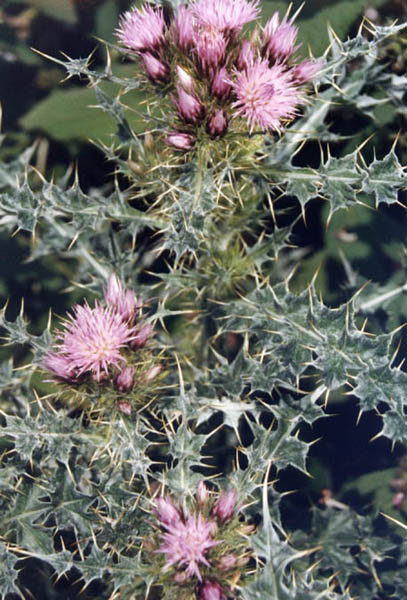
Its morphology varies considerably depending on the altitude. In the highest levels, the plant is reduced to an almost stemless rosette, very spread out, lying on the ground between the stones, with deeply lobed leaves armed with robust spines covered with a dense silver-gray tomentum, a characteristic immediately visible in the field. At lower altitudes, winged and spiny stems develop, carrying the flower heads at a height of 20 to 50 cm.
The flower heads, bright pink-purple to lilac, are sessile or briefly pedunculated, clustered at the heart of the rosette in the alpine form, or arranged along the stems in the more upright form. The bracts of the involucre are narrowly spiny and bristly.
In its natural habitat, its flowering extends from July to August.
It requires a mineral soil, very well-drained, in full sun, and perfectly tolerates intense cold and summer drought.