Perennial of the Brassicaceae family, Cardamine asarifolia is native to the mountains of southern Europe, from the Pyrenees to the Apennines and the southern Alps, where it grows by torrents, in springs, rocky seepages, and shaded moist hollows, generally between 800 and 2,000 meters in altitude.
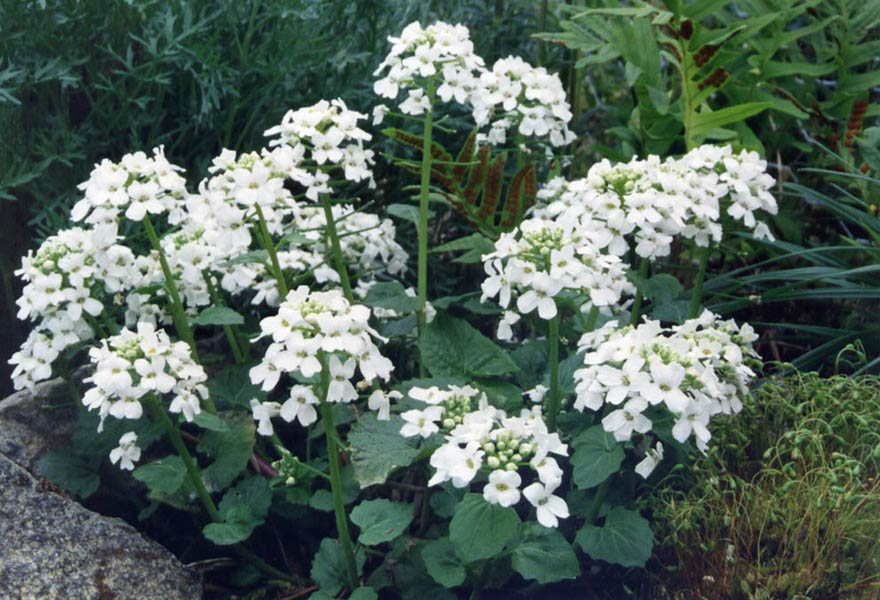
It forms vigorous and dense clumps, 30 to 50 cm in height in bloom, borne by upright and robust stems. The leaves are large, kidney-shaped to heart-shaped, dark green and shiny, reminiscent of those of the wild ginger, as its specific epithet suggests.
The flowers are white, with four well-developed petals, gathered in dense and very full corymbs that crown the stems with remarkable generosity. The whole in full bloom forms a dome of pure white particularly luminous, with a striking effect in shaded situations.
In its natural habitat, its flowering extends from May to July depending on the altitude. In cultivation, it generally occurs in May-June.
It requires a constantly fresh to moist soil, rich in humus, in shade or partial shade, and does not tolerate summer drought. It is perfectly suited to moist woodland gardens and stream banks.