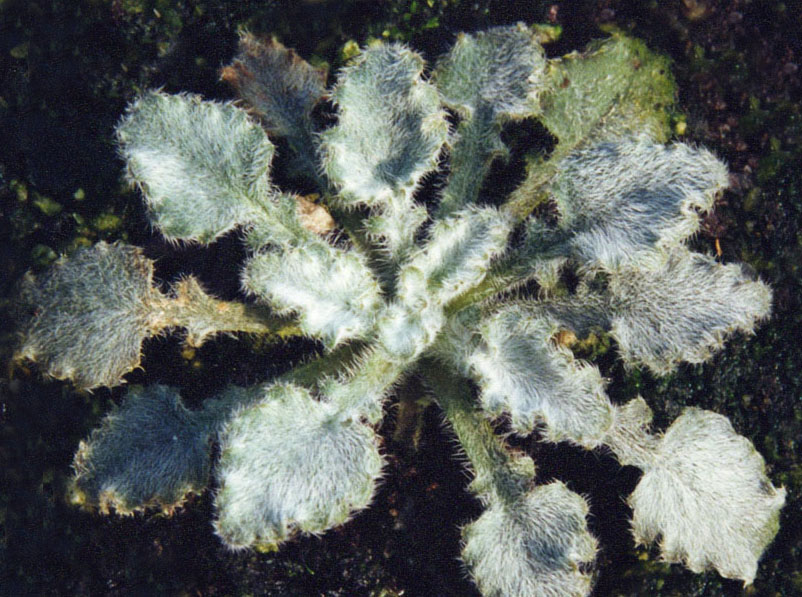
A biennial of the Campanulaceae family, this subspecies is endemic to Greece, where it is confined to the limestone massifs of the Peloponnese. It colonizes screes, rock fissures, and dry rockeries very exposed to the sun, at moderate to mountainous altitudes.
It is distinguished from the type subspecies by its basal leaves, clearly cordate at the base, wider and more deeply crenate, always covered with a dense tomentum that gives them this so recognizable silvery-gray hue. The rosette, flattened and spread against the rocky substrate, is particularly decorative outside of flowering, with this sculpted and downy foliage that almost evokes a succulent plant in its way of clinging to the ground.
The flowering stems, slender and pubescent, often tinged with reddish, bear elongated tubular bells with spreading lobes, of a bright violet-lilac, slightly downy on the calyx and the base of the corolla.
In its natural habitat, its flowering extends from May to July. In cultivation, it generally occurs from June to August. The plant dying after flowering, maintenance in collection relies on regular sowing.
It requires perfect drainage, a very mineral substrate, and a warm and bright exposure. Excess winter moisture is fatal to it; cultivation in an alpine trough or pot under an unheated cold frame remains the safest solution in climates with wet winters.