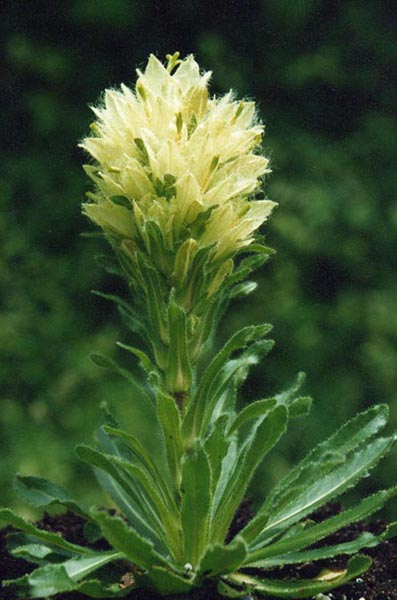
Monocarpic perennial of the Campanulaceae family, found in the Alps, the Jura, the Carpathians, and the northern Apennines. It occupies high-altitude calcareous grasslands, sunny rocky slopes, and lean meadows, generally between 1,500 and 2,800 meters, on well-drained calcareous or mixed substrates.
Its habit is immediately recognizable: a dense basal rosette of large oblong, hairy, and slightly wavy leaves, of a grayish-green, from which rises after several years a robust, single, erect stem, 20 to 50 cm high, entirely covered with sessile and densely hairy leaves.
The flowers, tightly packed in a compact terminal cylindrical spike, are creamy yellow to pale sulfur yellow, a very rare color in the Campanula genus, which is enough to distinguish the species at first glance. Each bell is short, slightly tubular, with slightly flared lobes, densely grouped along the entire length of the spike. The plant dies after this single flowering, at the end of a cycle that can last from three to eight years.
In its natural habitat, its flowering extends from July to August. In cultivation, it generally occurs at the same dates.
It requires a calcareous, well-drained soil, in full exposure. Propagation is exclusively by seed. Its long wait before flowering and its unusual color make it a particularly sought-after collector's item for alpine plant enthusiasts.