A perennial from the Campanulaceae family, endemic to Crete, where it inhabits the crevices of limestone cliffs, rocky areas, and sunny rocky slopes, mainly in the mountainous regions of the island, between approximately 500 and 1,800 meters altitude.
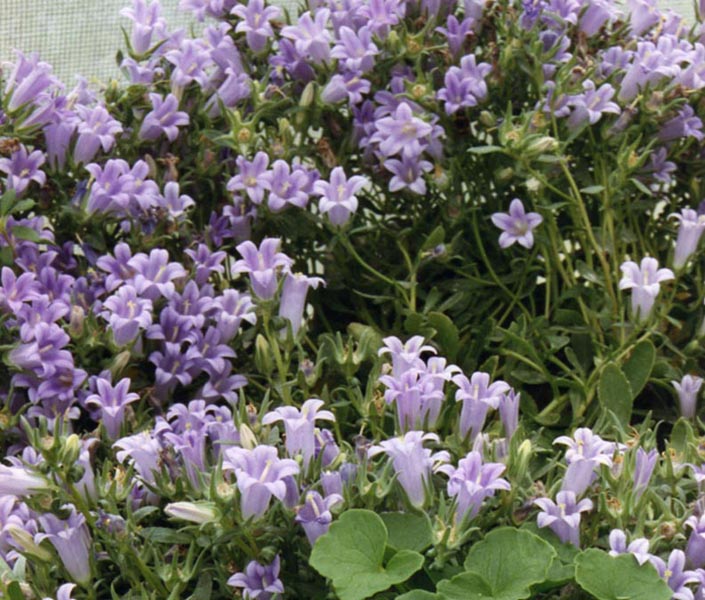
It forms semi-spreading to slightly upright clumps, 15 to 25 cm in height, with branched stems bearing medium to dark green foliage. The basal leaves are oval to kidney-shaped, slightly fleshy, with a crenate edge, while the cauline leaves gradually become narrower and sessile towards the top of the stems. The photograph clearly reveals this contrast in habit between the low rosettes and the more upright flowering stems.
The flowers are elongated bells with flared and reflexed lobes, in a medium lilac to bright lavender-violet, borne in numbers on well-branched stems. The flowering is generous and covers the entire plant with remarkable density, as evidenced by the image.
In its natural habitat, its flowering extends from May to July. In cultivation, it generally occurs from May to June.
It requires excellent drainage, a well-drained calcareous or mineral substrate, and full sun exposure. Sensitive to excess moisture in the cold season, it is profitably cultivated in alpine troughs or very well-drained rock gardens. A Mediterranean species of character, valuable for enthusiasts of bellflowers from the Aegean basin.