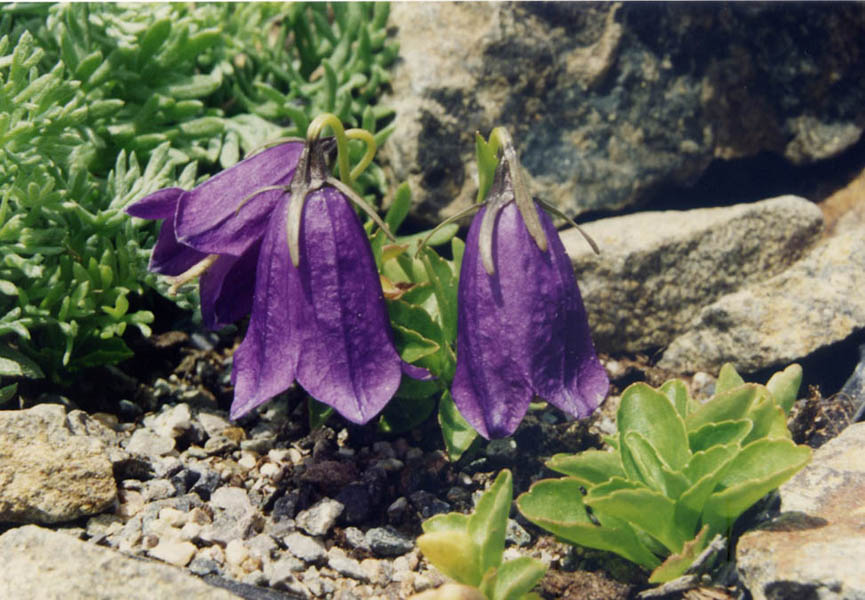
Perennial of the Campanulaceae family, endemic to the Eastern Alps, mainly from Austria and northern Slovenia. It inhabits rocky grasslands, crevices of limestone rocks, and stabilized screes of the subalpine and alpine levels, generally between 1,200 and 2,500 meters in altitude.
It is a miniature and stoloniferous plant, forming small loose tufts only 5 to 10 cm high, gradually spreading through its underground stolons to form discreet carpets. The foliage consists of small oval to spatulate, crenate leaves, with a shiny green, tightly packed in compact basal rosettes.
The flowers are solitary, borne on slender erect stems, in a deep and pendulous bell shape, with barely flared lobes, of a dark violet almost purple, with a quite remarkable color intensity for such a small plant. This dark and saturated hue, rare in the genus, is the most striking feature of the species and makes it immediately recognizable among alpine bellflowers.
In its natural habitat, its flowering extends from June to August depending on the altitude. In cultivation, it generally blooms from May to July.
It requires perfect drainage, a rocky calcareous substrate, poor in organic matter, and a sunny to lightly shaded exposure. It is ideally cultivated in alpine rock gardens, in a pot or cold culture box, sheltered from stagnant winter moisture.