Perennial of the Campanulaceae family, native to the calcareous massifs of the western Balkans, mainly the Dinaric Alps in Croatia and Bosnia-Herzegovina. It naturally colonizes rock crevices, old walls, and sunny calcareous screes, between approximately 300 and 1,500 meters in altitude.
It forms dense, mat-forming clumps, vigorously spreading, 10 to 15 cm in height, widely extending in all directions from the central pivot. The foliage is evergreen to semi-evergreen, composed of small cordate to reniform, crenate leaves, dark green and glossy, forming a compact and regular carpet even when not in bloom.
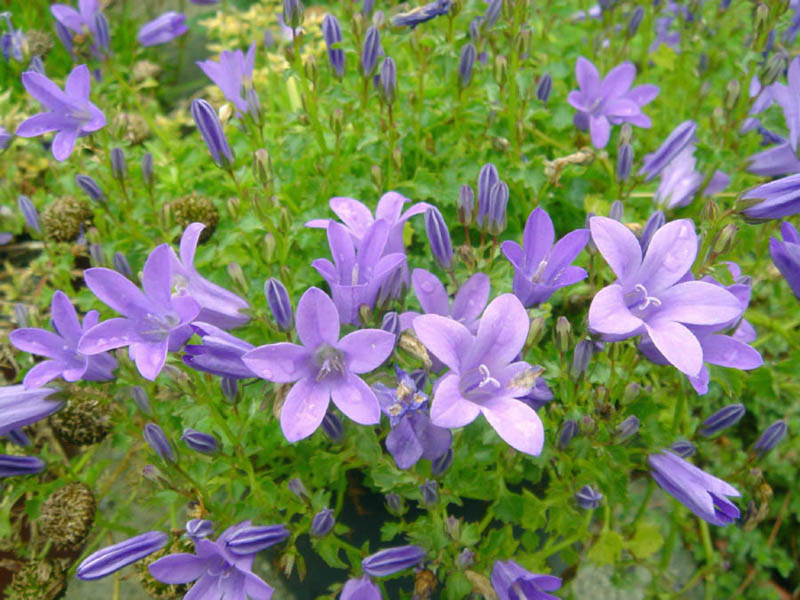
The flowers are funnel-shaped, with five well-marked lobes, a bright and deep blue-violet, borne in large quantities on short upright peduncles that emerge above the foliage. The flowering is remarkably generous, literally covering the foliage at the peak of anthesis.
In its natural habitat, flowering extends from June to August. In cultivation, it generally occurs from May to July, with sometimes a slight resurgence in autumn.
It thrives in full sun to partial shade, in any well-drained soil, preferably calcareous. Particularly at ease in walls, rock gardens, and raised planters, it withstands summer drought well once established. Hardy and robust, it is among the most reliable mat-forming bellflowers in cultivation.