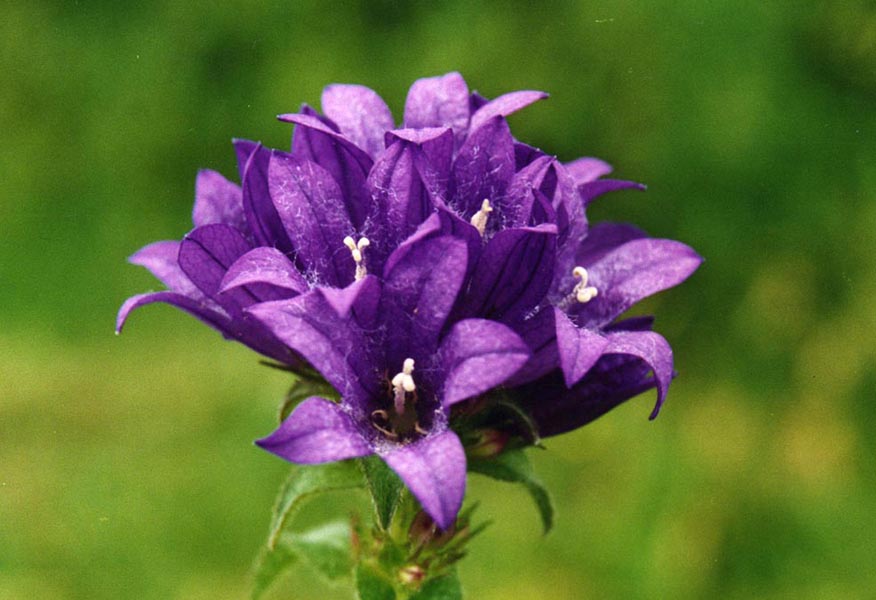
Perennial cultivar of the Campanulaceae family, selected from Campanula glomerata, a species with a wide Eurasian distribution, found in calcareous meadows, woodland edges, and grassy slopes of temperate Europe to Central Asia, from lowland to montane levels.
This dwarf cultivar is distinguished from the type species, which can reach 60 to 80 cm, by its very reduced size, generally not exceeding 15 to 20 cm in height. It forms compact and dense clumps, with an almost stemless habit as its name suggests, the flowers appearing to arise directly at the foliage level without a notable apparent stem.
The leaves are oval-lanceolate, slightly rough to the touch, medium green, with a heart-shaped base and crenate edges. The flowers, grouped in tight glomerules characteristic of the species, are a deep and intense purple-violet, tubular-campanulate, gathered in dense and compact heads that emerge directly from the clump.
In its natural habitat, the type species blooms from June to August. In cultivation, this cultivar generally blooms from May to July.
It thrives in ordinary to fresh, well-drained soil, in sunny to semi-shaded exposure. Its compactness makes it particularly suitable for ground-level rockeries, low borders, and container compositions, where the type species would be disproportionate.