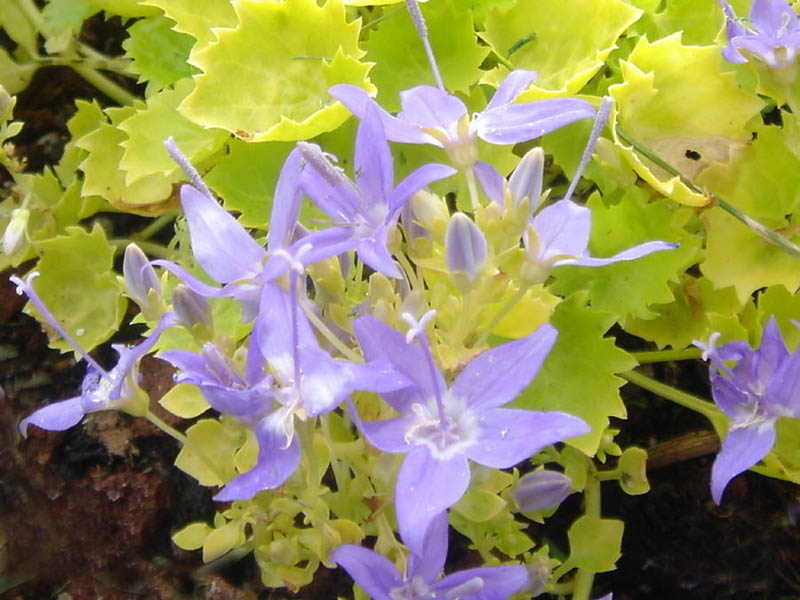
Perennial cultivar from the Campanulaceae family, selected from Campanula garganica, the wild species native to the Gargano promontory in Apulia and western Greece. This horticultural form is radically different from the type species due to the color of its foliage, which is its main originality.
It forms spreading and semi-trailing clumps, 10 to 15 cm in height, with a branched and dense habit. The leaves are kidney-shaped to heart-shaped, crenate, a golden yellow to bright chartreuse yellow, particularly vivid in spring and early summer, fading to a softer yellow-green in midsummer under intense heat. This persistent golden foliage is a decorative element in its own right, independent of flowering.
The star-shaped flowers, a bright lilac-blue with a white center, contrast strikingly with the golden foliage, creating an uncommon chromatic alliance in the Campanulaceae family. This complementarity between the blue of the flowers and the yellow of the leaves is the most immediately striking distinctive feature of the cultivar.
In its natural habitat, the type species blooms from May to July. In cultivation, this cultivar generally blooms from May to June.
It requires well-drained soil, in a semi-shaded to sunny exposure, avoiding full scorching sun which can discolor the foliage. It is suitable for rock gardens, walls, and troughs, where the golden foliage remains visible all season.