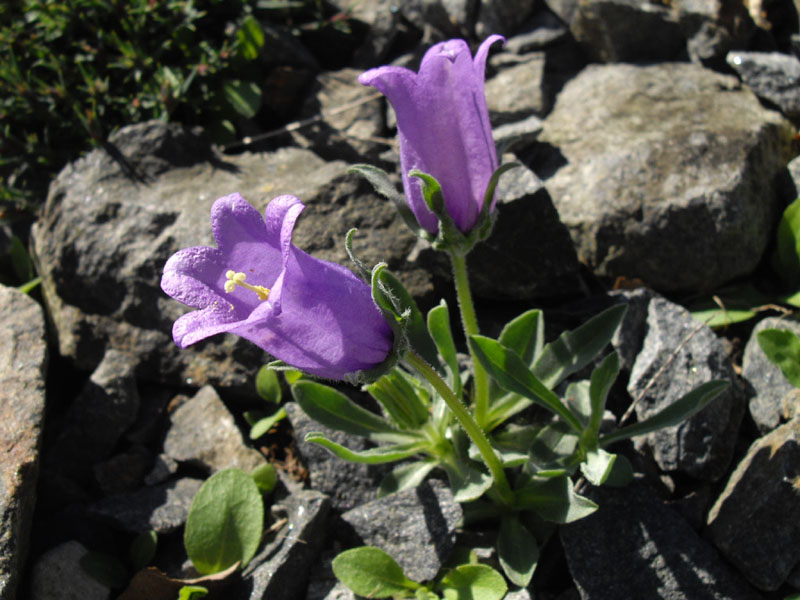
Perennial of the Campanulaceae family, endemic to the western and maritime Alps, where it colonizes moving scree, rock crevices, and stony slopes on siliceous or calcareous substrates, between 1,800 and 3,000 meters in altitude. It is a strictly mountainous plant, adapted to the harshest conditions of the alpine and subalpine levels.
It forms small low and compact tufts, rarely beyond 5 to 10 cm in height, with narrow, linear, slightly ciliated leaves of a grayish-green. This tight cushion-like growth allows it to withstand the wind and intense cold of high altitudes.
The flowers, borne singly on short stems, are remarkably large in size compared to the plant: large upright bells, deep blue-violet to lilac, reaching 4 to 5 cm in length, with slightly flared lobes. This contrast between the small stature and the generosity of the flower is one of the most striking features of the species.
In its natural habitat, its flowering extends from July to August. In cultivation, it blooms in June-July. It requires very well-drained, rocky soil, in full sun, with limited winter moisture. Delicate in the plains, it is best cultivated in alpine rock gardens or in raised troughs.