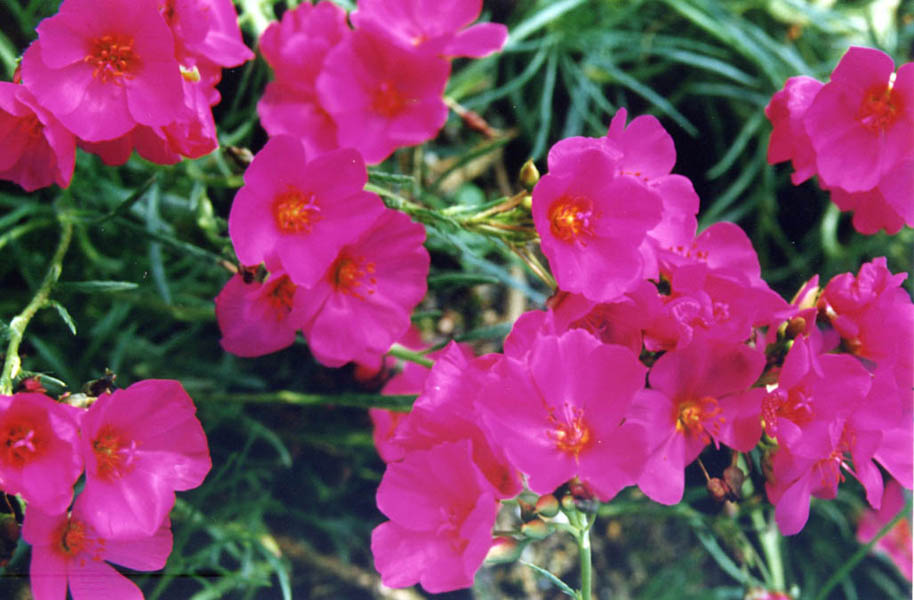
Perennial of the Montiaceae family, native to Peru and Chile, where it grows on dry rocky slopes and well-exposed sandy terrains, at low and medium altitude. Frost-sensitive, hardy only down to about -5 to -8°C in perfectly drained conditions, it is often treated as an annual or biennial in cold temperate climates.
The plant forms small dense and spreading cushions, reaching 10 to 15 cm in height, with creeping to semi-upright stems. The leaves are narrow, linear, fleshy, grayish-green to glaucous-green, arranged in compact basal rosettes. This succulent, tight, and matte foliage is one of the plant's assets even before flowering.
The 'Amaranth' cultivar is distinguished by its intense and velvety crimson-amaranth flowers, with five widely open petals, borne in umbels on short upright stems above the foliage. The particularly saturated color contrasts strikingly with the gray-green leaves.
In its natural habitat, its flowering extends from November to February (austral summer). In cultivation under temperate climate, it blooms from June to August, mainly in sunny weather, the flowers closing in overcast conditions.
It requires full sun exposure, a very draining soil, dry to moderately fresh, and does not tolerate stagnant humidity. In regions with cold and wet winters, wintering in shelter or renewed annual sowing remain the most reliable solutions. It finds its place in dry rock gardens, on walls, or in raised containers.