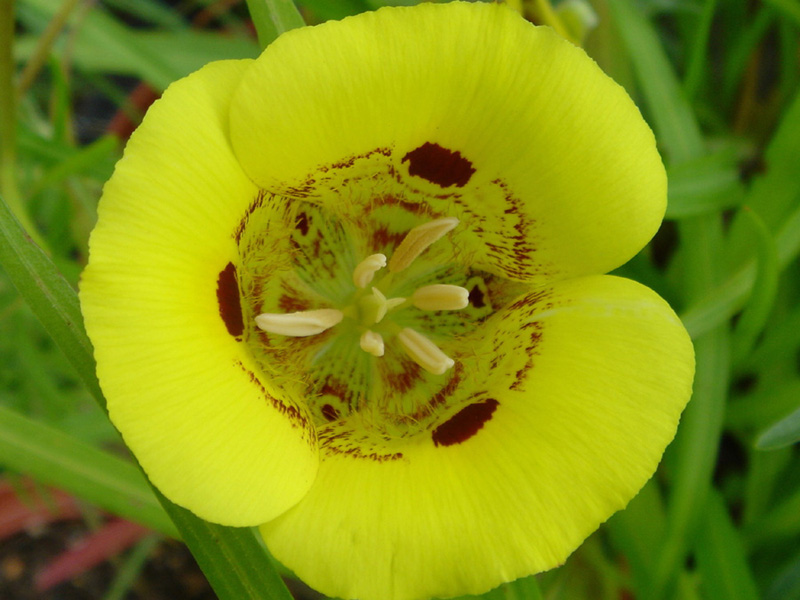
Cultivar derived from the genus Calochortus, family Liliaceae, whose parent species are native to the western United States, mainly California and adjacent states. Wild calochortus occupy dry meadows, scrublands, and well-drained rocky slopes, often on serpentine or sandy soils.
This cultivar forms a bulbous plant 30 to 50 cm tall, with upright stems and narrow, linear, discreet foliage. The flower is the main attraction: three large petals widely spread in a bright golden yellow, with a slightly satiny texture, characteristic of the genus that English speakers call Mariposa lily — the butterfly lily — in reference to the graceful and airy shape of its flowers.
The inside of the petals often bears a darker or spotted basal zone, depending on the intensity of hybridization, giving the open flower a radiant appearance.
In its natural habitat, the parent species bloom from May to July. In cultivation, flowering occurs in June-July. Cultivation requires a very well-drained, poor soil, in full sun, with summer dryness respected after flowering. The bulbs dread stagnant winter humidity.