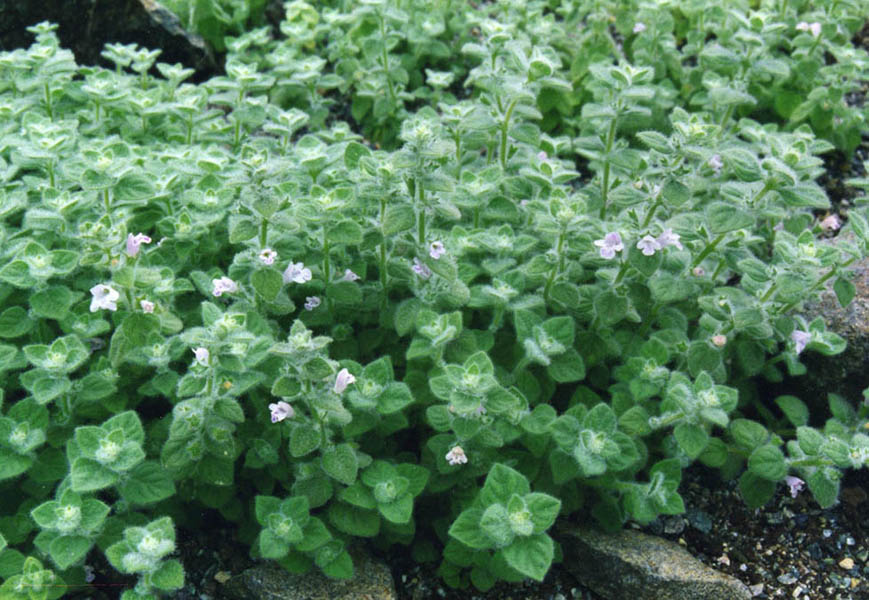
(Calamintha cretica)
(Calamintha cretica)
Perennial of the Lamiaceae family, native to the eastern Mediterranean basin, mainly Crete, the Aegean islands, and the southern Balkan peninsula, where it grows on limestone rocks, dry scree, and open garrigue, at low and medium altitudes.
The plant forms small, loose, and spreading bushes, reaching 15 to 30 cm in height, with woody stems at the base, densely covered with a whitish tomentum that gives it a characteristic and immediately recognizable grayish appearance. The leaves are small, oval to rounded, also tomentose on both sides, releasing a distinct aromatic scent when crushed.
The flowers, bright pink to pink-purple, are arranged in axillary whorls along the stems, typical of the genus. Their color contrasts pleasantly with the silvery gray foliage.
In its natural habitat, it blooms from May to July. In cultivation under a temperate climate, it blooms from June to August.
It requires full sun exposure, a very well-drained soil, preferably limestone, and poorly tolerates prolonged winter humidity. In rock gardens, it behaves like a crevice or wall plant, and withstands summer drought well.