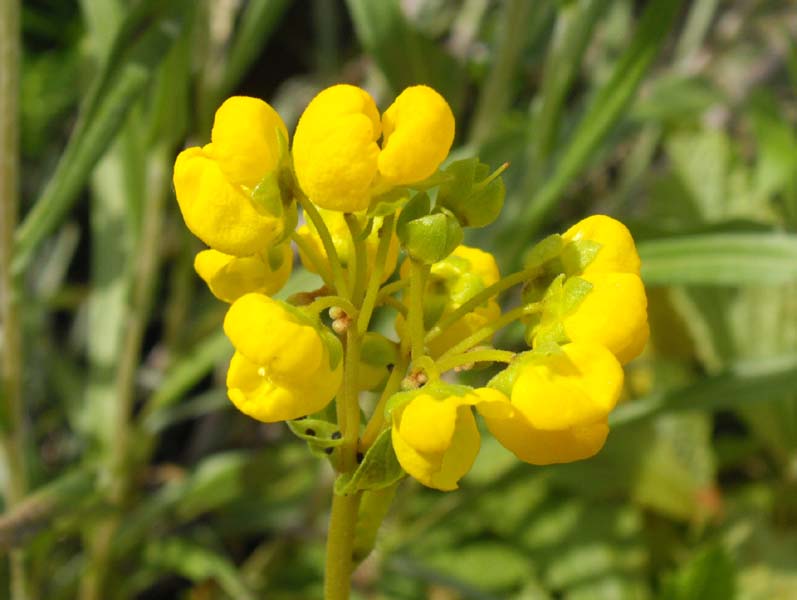
Perennial of the Calceolariaceae family, native to Chile and Argentina, where it grows on rocky slopes, screes, and high-altitude meadows, generally between 1,500 and 3,500 meters.
In cultivation, it forms basal rosettes of oval to oblong leaves, crenate at the edges, medium green to slightly yellowish, with a rough and embossed texture. From these rosettes rise slender, erect floral stems, reaching 20 to 40 cm, ending in a well-structured corymb of golden yellow flowers. In cultivation conditions, the plants tend to develop a broader habit and more slender stems than in their natural high-altitude habitats, where cold and wind constrain them to a more compact form.
The flowers, gathered in dense and regular umbels, are bilabiate and characteristic of the genus: the lower lip, very swollen and rounded into a pouch, largely dominates the upper lip reduced to a small cap. Their grouping in a tight corymb gives the inflorescence an almost geometric appearance, particularly clear and elegant.
In its natural habitat, its flowering extends from November to February (austral summer). In cultivation under temperate climates, it blooms from June to August.
It requires very well-drained soil, poor to moderately rich, in full exposure or slight partial shade. Its hardiness is estimated down to -10°C in dry conditions. It is suitable for collection rock gardens and trough cultivation, where the clarity of its bright yellow corymbs easily distinguishes it from other alpine calceolarias.